Adaptive Agentic SDLC: Building Self-Evolving Software with AI
Explore the next evolution of software development beyond traditional SDLCs and one-shot AI code generation. Discover how Adaptive Agentic SDLC promises truly self-evolving software systems that adapt, heal, and learn from real-world feedback.
The software development landscape is in a perpetual state of flux. Requirements shift, user behaviors evolve, security threats emerge, and underlying technologies change at an unprecedented pace. Traditional Software Development Lifecycles (SDLCs), even agile methodologies, often struggle to keep pace with this relentless dynamism. The current wave of AI-driven code generation, while impressive, often treats development as a series of isolated, "one-shot" tasks. But what if our software systems could not only be built by AI but also adapt, evolve, and self-heal autonomously in response to continuous, real-world feedback? This is the promise of Adaptive Agentic SDLC, a paradigm shift that moves beyond mere code generation to create truly self-evolving software.
The Limitations of Static Development in a Dynamic World
Imagine a scenario where a critical microservice in your production environment starts experiencing performance degradation. In a traditional setup, this would trigger alerts, involve engineers in debugging sessions, lead to manual code changes, testing, and then a deployment. This reactive process is resource-intensive and often introduces delays. Even with highly agile teams, the cognitive load of constantly re-evaluating, re-designing, and re-implementing significant portions of a system can be overwhelming.
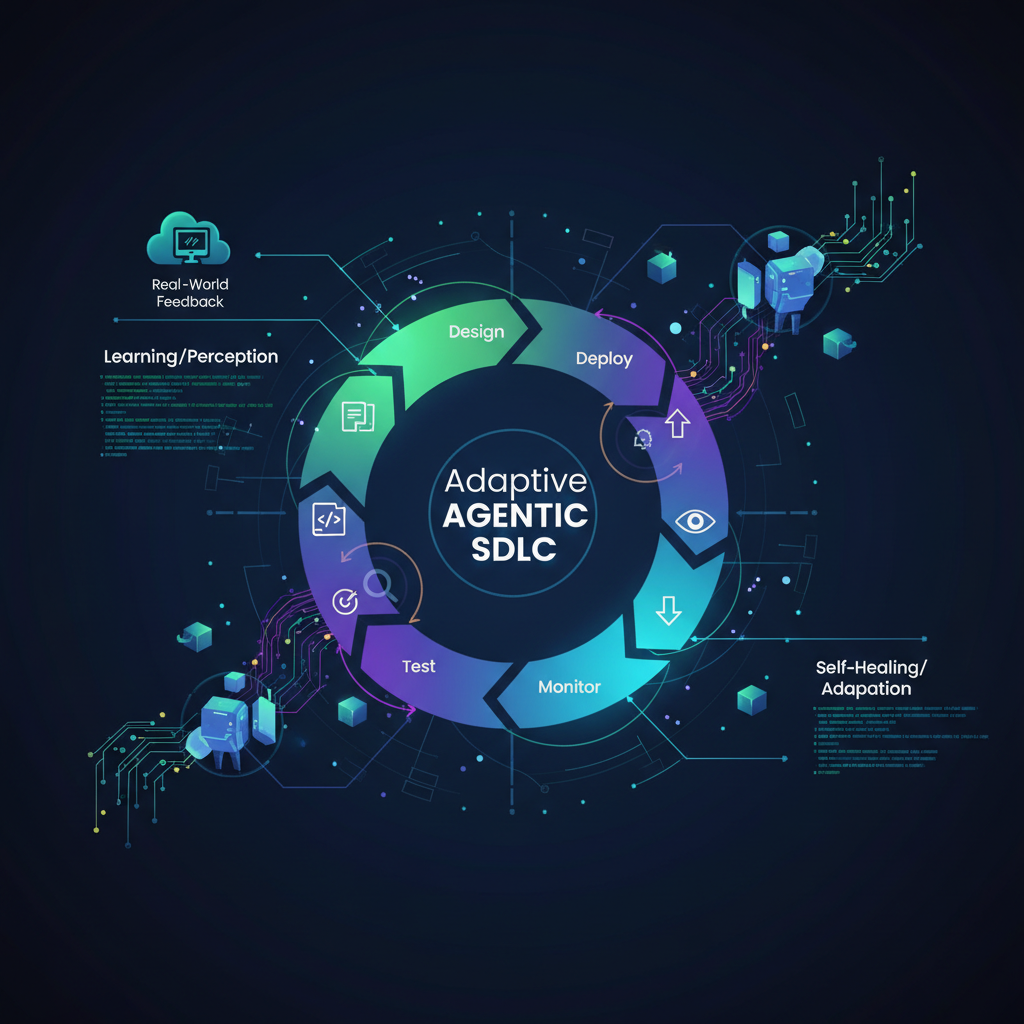
Current agentic coding efforts, while powerful, often focus on generating a specific piece of code or completing a predefined task based on an initial prompt. They excel at translating a clear specification into executable code. However, the real-world rarely offers such static clarity. Requirements are fluid, external APIs change without warning, and user expectations are a moving target. The true potential of AI agents lies not just in their ability to build software, but in their capacity to live with it, continuously monitoring, analyzing, planning, executing, and refining the application in a closed-loop fashion. This is the core tenet of Adaptive Agentic SDLC: building software that inherently possesses the intelligence to adapt and evolve.
Multi-Agent Orchestration for Continuous Adaptation
The journey towards self-evolving software begins with a fundamental shift from single, monolithic AI agents to sophisticated teams of specialized agents. Just as a human development team comprises roles like business analysts, architects, developers, testers, and operations engineers, an adaptive agentic system leverages a diverse array of AI agents, each with a distinct role and expertise.
Trend: Moving from single "coder agents" to sophisticated teams of specialized agents.
Technical Details & Development: Frameworks like AutoGen, CrewAI, and custom LLM-based orchestrators are pivotal here. These frameworks provide the scaffolding for defining agent roles, communication protocols, and task delegation. Each agent is typically an LLM (Large Language Model) augmented with tools, memory, and specific instructions (its "persona").
- Requirements Listener Agent: This agent continuously monitors external sources for changes. This could involve:
- Parsing user feedback from support tickets, social media, or in-app surveys.
- Analyzing market trends and competitor offerings.
- Monitoring changes in third-party API documentation.
- Scanning regulatory updates relevant to the application domain.
- Tools: NLP for sentiment analysis, web scraping tools, API clients for external services.
- Architecture Agent: Responsible for maintaining the system's overall design and ensuring new changes align with architectural principles. It evaluates proposed changes from a holistic perspective.
- Tools: Knowledge base of architectural patterns, static analysis tools, dependency graph visualizers.
- Coder Agent(s): Specializes in generating, modifying, and refactoring code. There might be multiple coder agents, each specialized in a different language, framework, or domain (e.g., frontend, backend, database).
- Tools: IDE-like capabilities, access to version control systems, code generation libraries.
- Tester Agent: Generates, executes, and analyzes test cases. It ensures that changes introduced by other agents do not break existing functionality and that new features are adequately covered.
- Tools: Test framework integration (JUnit, Pytest, Playwright), code coverage tools.
- Deployment Agent: Manages the deployment pipeline, ensuring that approved changes are safely rolled out to staging and production environments.
- Tools: CI/CD pipeline integration (Jenkins, GitHub Actions, GitLab CI), container orchestration tools (Kubernetes).
- Monitoring Agent: Observes the deployed system's health, performance, and user interaction patterns. It feeds telemetry data back into the system, often triggering new adaptation cycles.
- Tools: APM tools (Datadog, New Relic), logging systems (ELK stack, Splunk), anomaly detection algorithms.
- Refactoring Agent: Focuses on code quality, maintainability, and technical debt. It identifies opportunities for improvement and proposes refactoring tasks.
- Tools: Static code analyzers (SonarQube), linters, code complexity metrics.
Practical Example: Consider an e-commerce platform. A "Requirements Listener Agent" detects a surge in user complaints about a cumbersome checkout process through support tickets and app reviews. It summarizes these findings and briefs the "Architecture Agent" and "Coder Agent." The Architecture Agent might suggest a new microservice for payment processing to improve modularity. The Coder Agent then generates the necessary code for this new service and integrates it. Simultaneously, the "Tester Agent" automatically generates new end-to-end test cases for the revised checkout flow. The "Refactoring Agent" might identify that the existing database schema needs optimization to support the new payment service efficiently and proposes changes. This entire cycle happens with agents collaborating, debating potential solutions, and reaching a consensus before presenting a refined plan for human review.
Integration of Real-time Monitoring and Feedback Loops
For software to truly adapt, it must be aware of its own performance and environment. This means moving beyond agents building software to agents living with it, constantly consuming and interpreting real-time operational data.
Trend: Agents are no longer just building software; they are living with it.
Technical Details & Development: This involves robust mechanisms for feeding structured and unstructured operational data back into LLM-based agents.
- RAG (Retrieval Augmented Generation) over Logs: Agents can query extensive logs, error reports, and performance metrics using natural language. For instance, an agent could ask, "Show me all errors related to the
UserServicein the last hour with a severity ofCRITICAL." The RAG system retrieves relevant log entries, which the LLM then analyzes to identify patterns or root causes. - Anomaly Detection Triggering: Traditional monitoring systems can detect deviations from normal behavior (e.g., sudden spike in latency, increased error rates). These anomalies can directly trigger an "Investigation Agent" or "Troubleshooting Agent" within the multi-agent system.
- Semantic Parsing of User Feedback: Beyond simple keyword matching, agents can use advanced NLP to understand the intent and sentiment behind user feedback, translating qualitative input into actionable technical requirements.
Practical Application: Imagine a deployed microservice responsible for image processing. A "Monitoring Agent" continuously observes its latency and resource utilization. It detects a sudden, sustained increase in latency for image uploads. This anomaly triggers an "Investigation Agent." This agent, using RAG over application logs and system metrics, identifies that a specific image transformation algorithm is consuming excessive CPU for larger images. It then briefs a "Coder Agent" about the bottleneck. The Coder Agent, leveraging its knowledge base and access to optimization tools, proposes an alternative, more efficient algorithm or suggests implementing a caching layer for frequently processed images. It generates the new code, the "Tester Agent" creates performance tests to validate the fix, and upon successful testing, the "Deployment Agent" rolls out the update, potentially with human oversight.
# Conceptual example: Anomaly detection triggering an agent
class MonitoringSystem:
    def __init__(self, agent_orchestrator):
        self.agent_orchestrator = agent_orchestrator

    def detect_anomaly(self, metric_data):
        # Simulate anomaly detection logic
        if metric_data["latency"] > THRESHOLD:
            print("Anomaly detected: High latency!")
            # Trigger an investigation agent
            self.agent_orchestrator.trigger_agent(
                "InvestigationAgent",
                {"anomaly_type": "high_latency", "metric_data": metric_data}
            )

# In the agent_orchestrator:
# def trigger_agent(agent_name, context):
#     agent = self.get_agent_instance(agent_name)
#     agent.process_context(context)
# Conceptual example: Anomaly detection triggering an agent
class MonitoringSystem:
    def __init__(self, agent_orchestrator):
        self.agent_orchestrator = agent_orchestrator

    def detect_anomaly(self, metric_data):
        # Simulate anomaly detection logic
        if metric_data["latency"] > THRESHOLD:
            print("Anomaly detected: High latency!")
            # Trigger an investigation agent
            self.agent_orchestrator.trigger_agent(
                "InvestigationAgent",
                {"anomaly_type": "high_latency", "metric_data": metric_data}
            )

# In the agent_orchestrator:
# def trigger_agent(agent_name, context):
#     agent = self.get_agent_instance(agent_name)
#     agent.process_context(context)
"Self-Healing" and "Self-Optimizing" Codebases
The ultimate goal of adaptive systems is to move beyond reactive problem-solving to proactive improvement. Agents should not just fix bugs but prevent them, and not just meet requirements but exceed them by optimizing the system's underlying structure and performance.
Trend: Agents are evolving from reactive bug fixing to proactive system improvement.
Technical Details & Development: This involves agents possessing deep knowledge of code quality, security best practices, and performance optimization techniques, often trained on vast codebases and vulnerability databases.
- Proactive Security Scanning: Agents can continuously scan the codebase for known vulnerabilities (e.g., OWASP Top 10, CVE databases), deprecated libraries, or insecure coding patterns. They can use static analysis tools and even generate proof-of-concept exploits to validate findings.
- Architectural Debt Identification: Over time, software accumulates technical debt. Agents can analyze code complexity, module dependencies, and adherence to architectural principles to identify areas ripe for refactoring or re-architecture.
- Performance Optimization: Based on runtime characteristics observed by monitoring agents, other agents can propose and implement optimizations such as:
- Caching strategies.
- Database query optimization.
- Algorithm selection.
- Resource allocation adjustments (e.g., scaling up/down services).
Practical Application: A "Refactoring Agent" periodically scans the entire application codebase. It identifies several instances where an outdated library with known security vulnerabilities is being used. It also flags a complex, highly coupled module that frequently undergoes changes. For the vulnerabilities, it generates pull requests (PRs) to update the library to a secure version, including necessary code adaptations. For the complex module, it proposes a plan to break it down into smaller, more manageable microservices, generating the new service definitions, API contracts, and migration strategies. These proposed changes are then presented to human developers for review and approval, ensuring that the codebase remains healthy, secure, and maintainable over its entire lifecycle.
# Conceptual example: Agent identifying and fixing a security vulnerability
class SecurityAgent:
    def __init__(self, code_scanner, vulnerability_db, coder_agent):
        self.code_scanner = code_scanner
        self.vulnerability_db = vulnerability_db
        self.coder_agent = coder_agent

    def scan_and_fix(self, codebase_path):
        vulnerabilities = self.code_scanner.scan(codebase_path)
        for vuln in vulnerabilities:
            if self.vulnerability_db.is_known(vuln.id):
                print(f"Found known vulnerability: {vuln.description}")
                # Agent proposes a fix
                fix_proposal = self.coder_agent.propose_fix(vuln)
                # This fix_proposal would then go through testing and human review
                print(f"Proposed fix: {fix_proposal.description}")
# Conceptual example: Agent identifying and fixing a security vulnerability
class SecurityAgent:
    def __init__(self, code_scanner, vulnerability_db, coder_agent):
        self.code_scanner = code_scanner
        self.vulnerability_db = vulnerability_db
        self.coder_agent = coder_agent

    def scan_and_fix(self, codebase_path):
        vulnerabilities = self.code_scanner.scan(codebase_path)
        for vuln in vulnerabilities:
            if self.vulnerability_db.is_known(vuln.id):
                print(f"Found known vulnerability: {vuln.description}")
                # Agent proposes a fix
                fix_proposal = self.coder_agent.propose_fix(vuln)
                # This fix_proposal would then go through testing and human review
                print(f"Proposed fix: {fix_proposal.description}")
Generative AI for Test Case Evolution and Validation
Testing is often the bottleneck in traditional SDLCs, and this challenge is amplified in adaptive systems where code changes continuously. Agents are proving to be invaluable in automating and evolving the testing process itself.
Trend: Testing is often the bottleneck in adaptive systems. Agents are becoming adept at generating, evolving, and executing tests.
Technical Details & Development: LLMs, with their understanding of natural language and code, can generate diverse and comprehensive test cases.
- Requirement-driven Test Generation: When a "Requirements Listener Agent" identifies a new feature or a modification, a "Test Generation Agent" can automatically create new unit, integration, and end-to-end tests based on the updated specifications.
- Behavioral Test Generation: By analyzing user interaction logs or observed system behavior, agents can generate tests that mimic real-world usage patterns, uncovering edge cases that might be missed by manual test design.
- Test Suite Evolution: As code changes, existing tests might become obsolete or insufficient. Agents can analyze code changes and automatically update or generate new tests to maintain comprehensive coverage.
- Root Cause Analysis of Test Failures: When a test fails, an agent can analyze the failure logs, compare expected vs. actual behavior, and even inspect the relevant code changes to pinpoint the likely root cause, accelerating debugging.
Practical Application: A "Coder Agent" has just implemented a new feature allowing users to customize their profile page. The "Test Generation Agent" immediately kicks in. It reads the feature specification and generates a suite of new unit tests for the backend API endpoints, integration tests for the frontend-backend interaction, and end-to-end tests using a browser automation framework like Playwright. These tests cover various scenarios, including valid inputs, invalid inputs, edge cases (e.g., extremely long user bios, special characters), and performance under load. If any of these tests fail, a "Troubleshooting Agent" analyzes the failure report and the recently modified code, suggesting potential fixes directly to the Coder Agent, thereby creating a tightly integrated and self-correcting development loop.
Human-in-the-Loop for Trust and Governance
While the vision is autonomous systems, complete hands-off operation is rarely desirable, especially for critical applications. Human oversight, approval, and intervention remain crucial for trust, governance, and aligning agent actions with broader organizational goals.
Trend: While autonomy is the goal, human oversight, approval, and intervention remain crucial.
Technical Details & Development: This involves designing sophisticated Human-Agent Interaction (HAI) interfaces and robust notification systems.
- Approval Workflows: Critical decisions (e.g., major architectural changes, deployment to production, significant data model alterations) can be configured to require explicit human approval. Agents present their proposed changes, along with impact analyses, generated code, and test results, in an easily digestible format.
- Monitoring Dashboards: Developers and architects need clear dashboards to monitor agent activities, track their progress, view decision logs, and understand the reasoning behind proposed changes.
- Intervention Mechanisms: Humans must be able to pause, override, or redirect agent activities if they detect an issue or if new, unforeseen circumstances arise.
- Policy and Constraint Injection: Humans can inject new policies, constraints, or directives into the agent system, guiding their behavior and ensuring compliance with business rules, security policies, or ethical guidelines.
Practical Application: An "Architecture Agent" proposes a significant refactoring of the core data storage layer to improve scalability. This is a high-impact change. Instead of proceeding autonomously, the agent system triggers an approval workflow. It generates a detailed proposal document, including:
- Problem Statement: Why the change is needed (e.g., "Current database schema is a bottleneck for projected user growth").
- Proposed Solution: The new schema design, migration strategy, and impact on existing services.
- Impact Analysis: Estimated performance gains, potential risks, and resource implications.
- Generated Code: The DDL for the new schema, migration scripts, and updated ORM models.
- Test Results: Proof that the changes are thoroughly tested and don't introduce regressions.
This comprehensive package is presented to a human architect or a review board via a dedicated UI. The human can review the details, ask clarifying questions (which the agent system can answer by consulting its knowledge base or other agents), and then approve or reject the proposal. This ensures that while agents handle the complexity and execution, strategic decisions remain under human control.
Value for AI Practitioners and Enthusiasts
The Adaptive Agentic SDLC is not just a futuristic vision; it's a rapidly developing field with immense practical and intellectual appeal.
- Frontier Research: This area is a goldmine for novel research. How do agents maintain architectural integrity over hundreds of adaptation cycles? How can we ensure long-term coherence and prevent "drift"? What are the ethical implications of highly autonomous systems modifying production code? These are open questions ripe for exploration.
- Practical Impact: Imagine a world where software systems truly "live" and "breathe," adapting to user needs and market shifts without constant manual intervention. This promises unprecedented agility, reduced maintenance burden, and faster time-to-market for new features.
- Skill Development: Practitioners can develop expertise in designing multi-agent systems, integrating LLMs with operational data, building robust feedback loops, and creating intelligent automation for the entire software lifecycle. These skills will be highly sought after in the coming years.
- Ethical Considerations: This topic also forces critical discussions around accountability, control, and the potential for unintended consequences in highly autonomous systems. Addressing these challenges is vital for responsible AI development and deployment.
Challenges to Address
While the promise is immense, significant challenges remain:
- Long-term Coherence: How do agents maintain architectural integrity and code quality over hundreds or thousands of adaptive cycles? Preventing "architectural drift" or the accumulation of technical debt from autonomous changes is a complex problem.
- Trust and Explainability: How can we ensure humans trust the agents' decisions and understand their reasoning, especially for critical changes? Black-box decision-making is unacceptable in production systems.
- Computational Cost: Running complex multi-agent systems with continuous LLM interactions, extensive monitoring, and code generation can be resource-intensive and expensive.
- Security: Autonomous agents modifying production systems introduce new security vectors. Robust safeguards, access controls, and audit trails are paramount.
- "Hallucination" Mitigation: Preventing agents from generating non-sensical, inefficient, or harmful code/decisions remains a challenge. The reliability and safety of agent-generated code must be extremely high.
- State Management and Memory: How do agents maintain long-term memory of past decisions, architectural constraints, and evolving context across multiple adaptation cycles?
Conclusion
The Adaptive Agentic SDLC for Dynamic Requirements represents a profound leap from current agentic coding efforts. It envisions a future where software systems are not just built by AI, but are continuously maintained, evolved, and optimized by intelligent agents in a closed, intelligent loop. This paradigm promises to revolutionize how we conceive, develop, and operate software, enabling unprecedented levels of agility, resilience, and responsiveness to an ever-changing world. While significant challenges remain in areas like trust, explainability, and long-term coherence, the foundational technologies and architectural patterns are rapidly emerging. This is not just an interesting theoretical concept; it's a practical imperative for building resilient, agile, and future-proof software in an increasingly dynamic world, paving the way for truly self-evolving software systems.