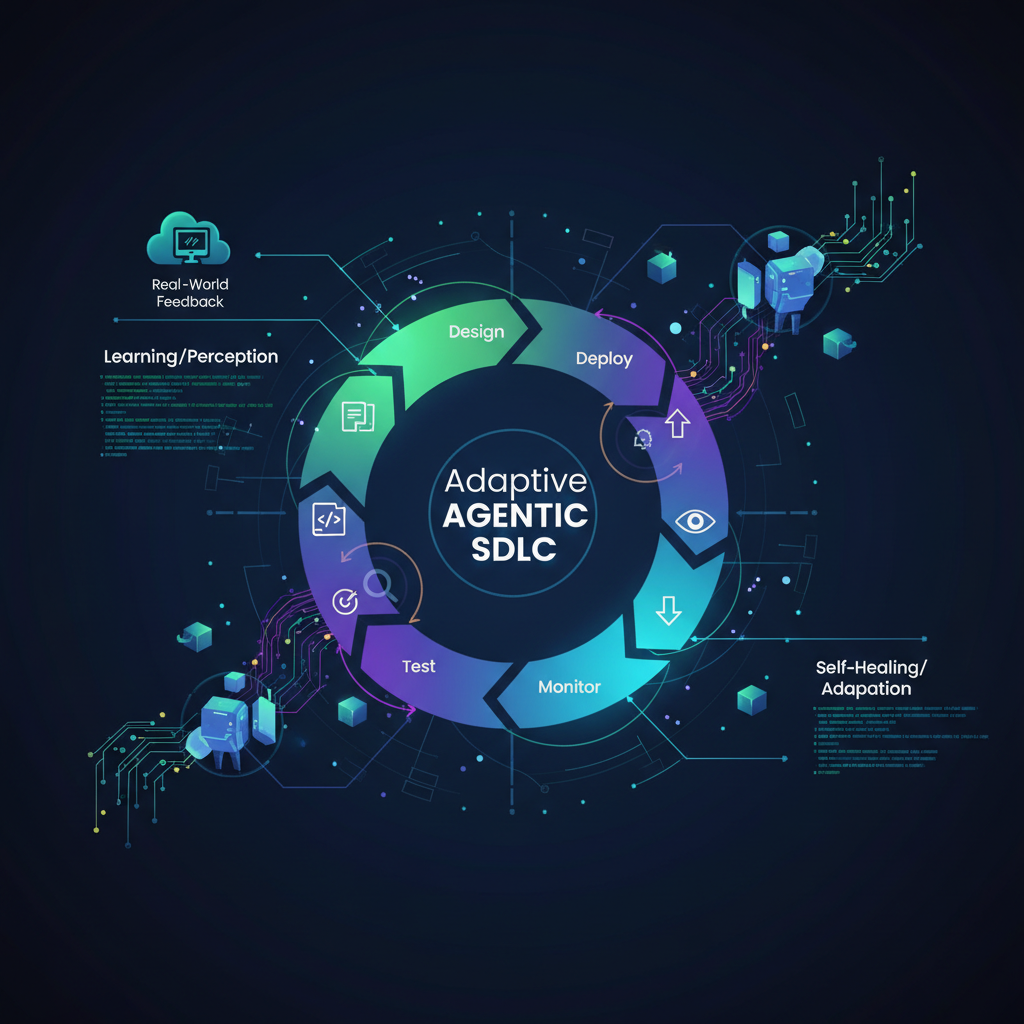
Adaptive Agentic SDLC: Self-Optimizing Software Development with AI Agents
Explore Adaptive Agentic SDLC, a paradigm where multi-agent AI systems autonomously manage software product evolution. This innovative approach moves beyond mere automation, building intelligent ecosystems that understand context, manage dependencies, and iterate with unprecedented agility, addressing the overhead of traditional agile methods.
The software development lifecycle (SDLC) has always been a dynamic beast, a constant dance between initial vision and evolving reality. Agile methodologies emerged precisely because static requirements are a myth. Yet, even with agile, human teams grapple with the immense overhead of continuous re-planning, re-prioritization, and refactoring in the face of shifting user needs, market demands, and technological landscapes. What if we could imbue the SDLC itself with an inherent capacity for adaptation, a self-optimizing system that responds autonomously or semi-autonomously to change?
This is the promise of Adaptive Agentic SDLC: a paradigm shift where multi-agent AI systems don't just automate tasks, but actively manage the evolution of a software product. It's about moving beyond mere code generation to building intelligent ecosystems that can understand context, manage dependencies, integrate, test, deploy, monitor, and iterate with unprecedented agility.
The Imperative for Adaptive SDLC
Why is this topic not just interesting, but critically timely?
- The Reality of Software Evolution: Software is never "done." It lives, breathes, and must evolve. Traditional SDLC models, even agile ones, often struggle to keep pace with the velocity of change required in today's digital world. The overhead of human-driven adaptation is immense, leading to technical debt, delayed features, and missed market opportunities.
- Beyond Code Generation: While Large Language Models (LLMs) have revolutionized code generation, the true complexity of software development lies in the holistic process. An adaptive agentic system addresses the entire lifecycle – from understanding nuanced requirements to continuous monitoring and self-healing in production.
- Maturing Multi-Agent Frameworks: The rise of sophisticated frameworks like AutoGen, CrewAI, and advanced capabilities within LangChain has made it feasible to design and deploy complex multi-agent architectures. These tools provide the scaffolding for building collaborative AI teams that can tackle intricate SDLC challenges.
- Practical Value Proposition: For practitioners, this isn't theoretical. It offers tangible solutions to real pain points: reducing the burden of requirement drift, accelerating feature delivery, enhancing software resilience, and allowing human developers to focus on higher-level innovation rather than repetitive adaptation tasks.
- Ethical and Control Considerations: As with any powerful AI application, Adaptive Agentic SDLC brings crucial discussions to the forefront: the role of human-in-the-loop, ensuring safety and alignment, and defining the appropriate level of autonomy. These challenges make the field ripe for intellectual exploration and responsible innovation.
Key Developments and Emerging Trends
The vision of an adaptive, agentic SDLC is being shaped by several converging trends and recent developments in AI.
1. Hierarchical and Specialized Agent Architectures
The initial fascination with a single "super-agent" capable of everything has given way to a more pragmatic and effective approach: specialized, collaborative agents.
- Trend: Decomposing the complex SDLC into distinct roles, each handled by a specialized AI agent.
- Development: Frameworks like AutoGen are instrumental here, enabling the creation of conversational agents that can delegate tasks, engage in debates to refine solutions, and collaborate much like a human team. Imagine a "Requirements Agent," a "Design Agent," a "Coding Agent," a "Testing Agent," a "Deployment Agent," and a "Monitoring Agent," all working in concert.
- Adaptive Aspect: The true power emerges with an "Orchestrator Agent" or an "Evolution Agent." This master agent observes changes – be it new user feedback, market analysis reports, or updated policy documents – and intelligently triggers the relevant sub-agents. For instance, a change in a core business rule might activate the "Requirements Agent" to update specifications, which then prompts the "Design Agent" to re-evaluate architecture, and so on, creating a cascading, adaptive response.
2. Integration with Observability and Feedback Loops
Agents are no longer just creators; they are active consumers of real-world data, enabling them to react to actual system performance and user behavior.
- Trend: Agents are deeply integrated with operational data sources, moving beyond artifact generation to real-time data consumption.
- Development: This involves connecting agents to monitoring tools (e.g., Prometheus, Grafana), logging systems (e.g., ELK stack), and user feedback platforms. A "Monitoring Agent" can detect performance degradations or error spikes, while an "Analysis Agent" can interpret sentiment from user reviews or identify common pain points from support tickets.
- Adaptive Aspect: This real-time feedback is crucial. If the "Monitoring Agent" detects a sudden increase in latency, it can inform the "Evolution Agent." This, in turn, might prompt a "Performance Tuning Agent" to suggest configuration changes or a "Coding Agent" to identify and fix inefficient code paths, leading to autonomous performance optimizations or even new feature proposals based on observed usage patterns.
3. Self-Correction and Self-Healing Capabilities
Moving beyond mere error detection, agents are increasingly capable of autonomous error resolution.
- Trend: Agents are being designed to identify, diagnose, and autonomously resolve issues, from code bugs to deployment failures.
- Development: This involves training or prompting agents to recognize patterns indicative of problems (e.g., security vulnerabilities, runtime errors, deployment misconfigurations). They can then generate patches, refactor problematic code, or adjust deployment parameters.
- Adaptive Aspect: Consider a scenario where a "Testing Agent" fails a critical test suite after a new deployment. Instead of merely reporting the failure, the "Orchestrator Agent" can instruct a "Debugging Agent" to analyze logs and test results, pinpoint the root cause, and then task a "Coding Agent" to generate a fix. This fix is then automatically re-tested and, if successful, redeployed, forming a tight, self-healing loop.
4. Semantic Understanding of Requirements and Context
The ability of LLMs to understand natural language is being leveraged for a deeper comprehension of software requirements.
- Trend: Agents are becoming adept at interpreting ambiguous requirements, inferring implicit constraints, and understanding user intent from high-level descriptions.
- Development: Advanced LLMs allow "Requirements Agents" to disambiguate vague statements, identify potential conflicts between different user stories, and even infer unstated needs based on common software patterns or domain knowledge.
- Adaptive Aspect: As requirements evolve, the "Requirements Agent" can semantically compare new specifications with existing ones. It can identify overlaps, conflicts, or redundancies, and then propose optimal integration strategies, ensuring that the system adapts coherently rather than just adding features in isolation.
5. Human-in-the-Loop (HITL) for Governance and Oversight
Full autonomy, while appealing, carries significant risks. Acknowledging this, adaptive agentic systems are being designed with explicit human oversight.
- Trend: Integrating human developers, architects, and product managers into critical decision points within the agentic workflow.
- Development: Agentic SDLC systems incorporate explicit approval gates. For instance, major architectural shifts, significant new feature deployments, or critical bug fixes might require human sign-off. This ensures that high-impact decisions are vetted by human intelligence and domain expertise.
- Adaptive Aspect: The system can adapt autonomously to minor, well-understood changes, but defers to human judgment for high-impact or novel situations. Crucially, the agents can learn from human feedback and approvals, refining their decision-making processes over time and improving their alignment with human values and business objectives.
Practical Applications and Use Cases
The theoretical underpinnings of Adaptive Agentic SDLC translate into powerful, real-world applications.
1. Automated Microservice Evolution
- Scenario: A critical microservice needs to adapt to a breaking change in an external API specification or a new internal data model. Manually updating and testing numerous dependent services is time-consuming and error-prone.
- Agentic Solution: An API Monitoring Agent detects the change in the external API schema. It alerts an Orchestrator Agent, which then triggers a Schema Transformation Agent. This agent analyzes the old and new schemas, proposes necessary code changes (e.g., data serialization/deserialization logic, database migrations), and generates updated API client code. A Coding Agent integrates these changes into the microservice. Subsequently, a Testing Agent generates and executes new integration tests to validate the adaptation. Finally, a Deployment Agent oversees the phased rollout of the updated service, potentially using blue/green deployments to minimize risk.
2. Self-Optimizing Cloud Infrastructure
- Scenario: A popular e-commerce application experiences wildly fluctuating load during sales events, requiring dynamic scaling and resource allocation to maintain performance while controlling costs.
- Agentic Solution: A Monitoring Agent continuously tracks resource utilization (CPU, memory, network I/O), application performance metrics (latency, error rates), and user traffic patterns. An Anomaly Detection Agent identifies potential bottlenecks or underutilized resources. A Cloud Configuration Agent analyzes this data and suggests optimal changes to auto-scaling rules, instance types, serverless function memory allocations, or even database read replicas. A Deployment Agent applies these infrastructure changes. Crucially, a Cost Optimization Agent continuously monitors the financial impact of these changes, ensuring that performance gains don't lead to excessive spending, and can suggest further optimizations.
3. Feature Flag Management and A/B Testing Automation
- Scenario: Rapidly iterating on UI/UX features based on real-time user engagement data to find the most effective design.
- Agentic Solution: A Feature Agent proposes new UI variations based on design patterns or user feedback. A Coding Agent implements these variations behind feature flags, ensuring they can be toggled on/off without redeployment. A Metrics Agent tracks granular user engagement data (click-through rates, conversion rates, time on page) for each feature variant. An Analysis Agent performs statistical analysis on this data to determine the "winning" variant. The Orchestrator Agent then instructs the Feature Agent to roll out the winning feature to all users, or to revert to the original if no significant improvement is observed, automating the entire A/B testing lifecycle.
4. Autonomous Technical Debt Reduction
- Scenario: Over time, a large codebase accumulates technical debt – outdated libraries, complex functions, duplicated code, and security vulnerabilities – hindering development velocity and increasing maintenance costs.
- Agentic Solution: A Code Analysis Agent periodically scans the codebase for patterns indicative of technical debt (e.g., cyclomatic complexity, code duplication, deprecated API calls, known security vulnerabilities). A Refactoring Agent then generates refactored code snippets, proposes dependency updates, or suggests architectural improvements. A Testing Agent automatically generates new unit and integration tests for the refactored code and runs existing test suites to ensure no regressions. A Documentation Agent updates relevant documentation, comments, and architectural diagrams. All proposed changes are then presented to a human for review (HITL) before being committed and deployed.
Challenges and Future Directions
While the promise of Adaptive Agentic SDLC is immense, several challenges must be addressed for its widespread adoption.
- Trust and Explainability: How do we build trust in systems that autonomously make critical decisions about our software? Agents must be able to explain their reasoning, providing clear audit trails and justifications for their actions, especially when things go wrong.
- Safety and Alignment: Ensuring that agent goals are perfectly aligned with human values and business objectives is paramount. Unintended consequences, even from well-intentioned agents, could be catastrophic. Robust guardrails, ethical frameworks, and continuous monitoring are essential.
- Context Window Limitations: Managing the vast amount of code, documentation, historical data, and real-time operational context within the current limitations of LLM context windows is a significant hurdle. Advanced retrieval-augmented generation (RAG) techniques and more sophisticated memory architectures will be crucial.
- Emergent Behavior: Multi-agent systems can exhibit complex, emergent behaviors that are difficult to predict or control. Designing systems that are robust, predictable, and resilient to unexpected interactions among agents requires advanced simulation, formal verification, and continuous learning.
- Human-Agent Collaboration Patterns: The interface and workflow for humans to effectively collaborate with and oversee these adaptive agentic systems need careful design. It's not about replacing humans, but augmenting them. Intuitive dashboards, intelligent alerts, and clear approval mechanisms will be key.
Conclusion
Adaptive Agentic SDLC represents a profound evolution in how we conceive, build, and maintain software. By leveraging the power of multi-agent AI systems, we can move towards a future where software products are not just developed, but cultivated – continuously adapting, self-optimizing, and evolving in response to a dynamic world. This isn't about fully autonomous coding in a vacuum, but about creating intelligent ecosystems that empower human developers, reduce operational burdens, and unlock unprecedented agility. The journey is just beginning, offering rich ground for innovation, research, and practical implementation that will redefine the very fabric of software development.