AI Agents: Revolutionizing Adaptive Software Development & SDLC
Explore how AI agents are poised to transform the software development lifecycle by enabling autonomous adaptation to dynamic requirements and evolving environments, moving beyond static plans towards resilient, self-evolving systems.
The software development lifecycle (SDLC) has always been a dance between planning and adaptation. From Waterfall's rigid phases to Agile's iterative sprints, the goal has been to deliver valuable software efficiently. Yet, a fundamental challenge persists: real-world requirements are rarely static, and operational environments are in constant flux. Enter the era of AI agents, promising to revolutionize how we build software. While much of the current excitement focuses on agents generating code or automating tests, the true frontier lies in enabling these agents to not just follow a plan, but to adapt autonomously to dynamic requirements and evolving environments. This isn't just an incremental improvement; it's a paradigm shift towards truly resilient and self-evolving software systems.
The Static Plan Problem: Why Adaptation is Critical
Traditional SDLC models, even agile ones, often assume a relatively stable set of requirements within an iteration or release cycle. Human teams excel at interpreting subtle cues, negotiating changes, and course-correcting. However, this human-centric adaptation is inherently slow, costly, and prone to bottlenecks, especially in complex, large-scale systems.
The first wave of Agentic SDLC systems, while powerful, often inherited this "static plan" limitation. An agent might be given a detailed prompt to "build a user authentication module," and it would dutifully generate code, tests, and documentation. But what happens when:
- User feedback indicates a critical usability issue with the login flow?
- A new security vulnerability (CVE) is discovered in a core dependency?
- The cloud provider deprecates an API endpoint used by the system?
- Performance metrics show a sudden degradation in a specific microservice?
In these scenarios, a purely execution-focused agent would fail. It lacks the continuous awareness, interpretive capabilities, and autonomous decision-making to detect, understand, and respond to such changes without explicit human intervention. This gap between the promise of autonomous agents and the messy reality of fluid requirements is precisely what Adaptive Agentic SDLC aims to bridge.
What is Adaptive Agentic SDLC?
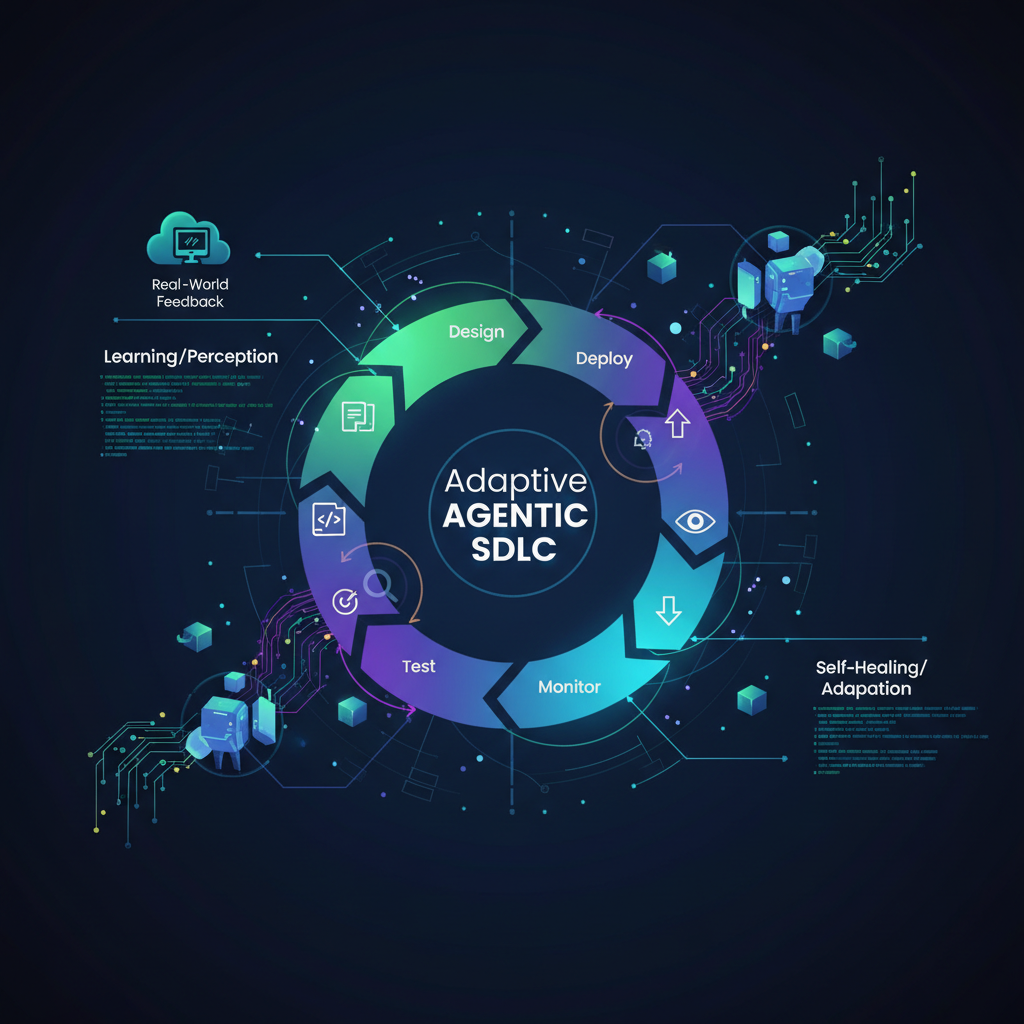
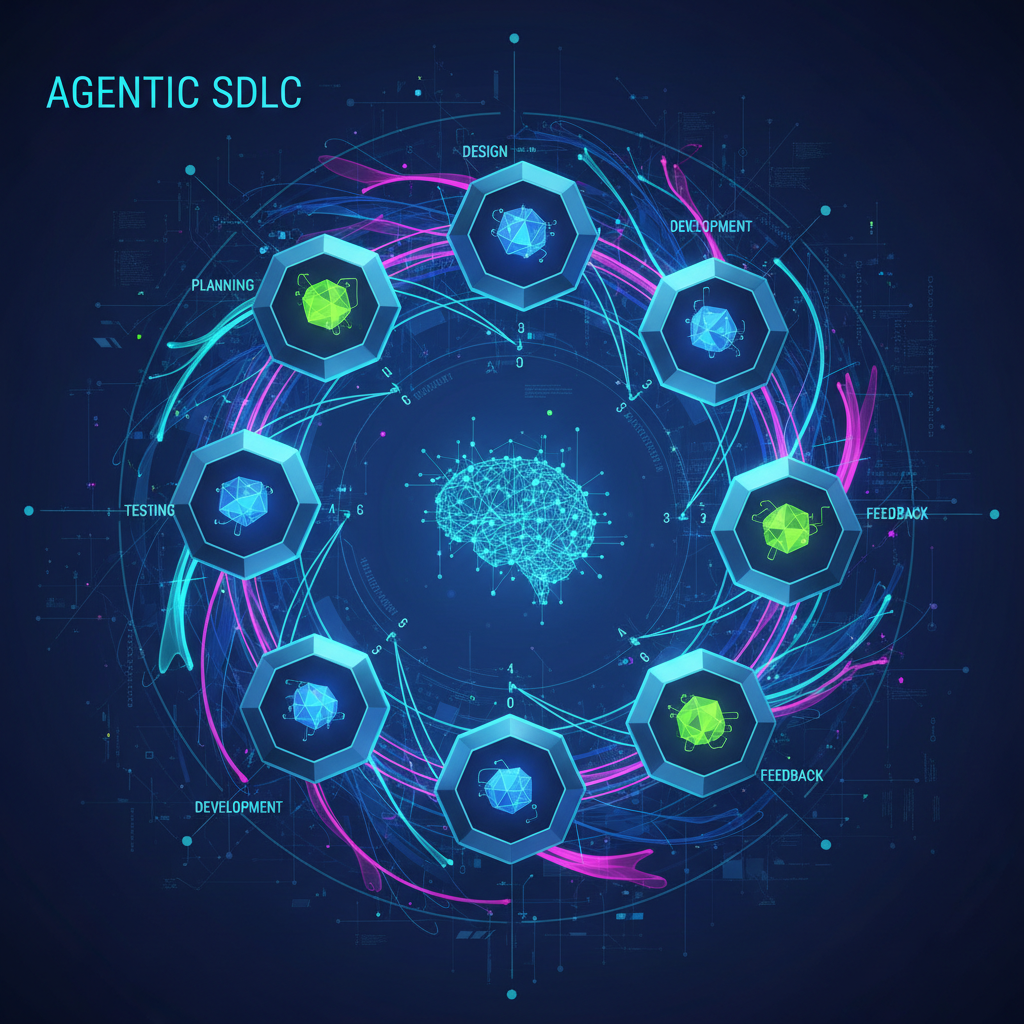
At its core, Adaptive Agentic SDLC is about designing and implementing an AI agent-driven software development pipeline that can intelligently and autonomously detect, interpret, adapt to, and incorporate changes throughout the entire SDLC. This includes everything from initial ideation and design to development, testing, deployment, and ongoing maintenance.
Instead of agents merely executing a pre-defined plan, this paradigm envisions a sophisticated ecosystem of agents capable of:
-
Continuous Monitoring: Agents constantly observe various data streams. This includes:
- User Behavior: Telemetry, clickstreams, support tickets, sentiment analysis from reviews.
- System Performance: Latency, error rates, resource utilization, throughput.
- External Data Sources: News feeds, competitor analysis, market trends, regulatory updates.
- Environmental Constraints: New API versions, deprecated libraries, security vulnerability databases (e.g., NVD), cloud provider service changes.
- Communication Channels: Internal team discussions, project management tools, customer feedback platforms.
-
Intelligent Interpretation: Upon detecting a change signal, agents don't just log it; they interpret its implications. This involves:
- Contextual Understanding: How does this change relate to the system's current goals, architecture, and existing codebase?
- Impact Analysis: What are the potential ripple effects of this change across different modules or services?
- Prioritization: Is this a critical, urgent change, or a minor enhancement?
-
Dynamic Re-planning & Re-architecting: Based on their interpretation, agents can adjust their development strategies. This might involve:
- Refactoring Code: Automatically identifying and rewriting sections of code to accommodate new requirements or improve efficiency.
- Proposing Architectural Shifts: Suggesting changes to microservice boundaries, data models, or infrastructure configurations.
- Adjusting Project Roadmaps: Re-prioritizing tasks, allocating resources (even if those "resources" are other agents), or initiating new development tracks.
-
Autonomous Execution of Adaptations: Once a new plan is formulated, agents take action:
- Code Generation & Modification: Writing new code or modifying existing code to implement the adaptation.
- Automated Testing: Generating and running new tests, or updating existing ones, to validate the changes.
- Deployment & Rollback: Managing the deployment process, potentially with canary releases or A/B testing, and having the capability to roll back if issues arise.
-
Reinforced Learning: Crucially, agents learn from their experiences. The success or failure of previous adaptations feeds back into their decision-making models, allowing them to refine their interpretation, planning, and execution strategies over time. This continuous learning loop is what makes the system truly "adaptive."
Why Now? The Confluence of Timely Innovations
The concept of self-adaptive systems isn't entirely new, but the convergence of several AI advancements makes Adaptive Agentic SDLC uniquely timely and achievable:
-
Advanced Multi-Agent Systems: Frameworks like AutoGen and CrewAI demonstrate how specialized agents can collaborate, negotiate, and delegate tasks. Imagine a "Requirements Agent" feeding validated changes to a "Code Generation Agent," which then coordinates with a "Testing Agent" and a "Deployment Agent." This distributed intelligence is vital for handling complex adaptations.
-
Long-Context Windows and Retrieval-Augmented Generation (RAG): Modern Large Language Models (LLMs) can process vast amounts of information, allowing agents to maintain a comprehensive understanding of a project's entire history, codebase, documentation, and external context. RAG enhances this by enabling agents to retrieve relevant, up-to-date information from external knowledge bases (e.g., API documentation, security advisories) in real-time.
-
Reinforcement Learning for Planning: RL algorithms can train agents to make optimal sequential decisions in dynamic environments. This is directly applicable to learning the best adaptation strategies, such as when to refactor, what architectural changes to propose, or how to prioritize conflicting requirements.
-
Cognitive Architectures: Moving beyond simple prompt-response, agents are evolving towards more sophisticated cognitive abilities:
- Self-reflection: Agents can evaluate their own performance and identify areas for improvement.
- Goal-directed behavior: They can maintain long-term objectives while adapting to short-term changes.
- Theory of Mind (rudimentary): In multi-agent systems, understanding the capabilities and limitations of other agents to delegate effectively.
-
"AI Engineers" and Devin-like Systems: The emergence of tools like Cognition Labs' Devin, while still in early stages, showcases the potential for agents to handle complex, multi-step development tasks from end-to-end. The next logical step is for these "AI engineers" to autonomously re-scope and re-plan those tasks based on new information, rather than just executing a static brief.
These advancements collectively provide the foundational capabilities for agents to move beyond mere automation to genuine autonomy and adaptation.
Practical Applications & Value for AI Practitioners
The implications of Adaptive Agentic SDLC are profound, offering immense practical value across various industries:
1. Automated Feature Evolution
Imagine a SaaS product where user feedback is not just collected but actively drives development.
- Scenario: Users frequently request a "dark mode" feature for a web application.
- Adaptive Agentic SDLC:
- A "Feedback Monitoring Agent" continuously analyzes user reviews, support tickets, and social media for feature requests.
- It detects a high volume of "dark mode" requests and, using sentiment analysis, identifies it as a highly desired feature.
- A "Requirements Agent" interprets this as a new, high-priority requirement and formalizes it (e.g., by generating a user story).
- A "Planning Agent" assesses the current codebase, identifies relevant UI components, and generates a development plan.
- A "Code Generation Agent" implements the dark mode, modifying CSS, JavaScript, and potentially backend settings.
- A "Testing Agent" automatically generates UI tests to ensure the dark mode functions correctly across different browsers and devices, and that existing functionality is not broken.
- A "Deployment Agent" orchestrates a phased rollout, monitoring A/B test results for user engagement and performance.
- Post-deployment, the "Feedback Monitoring Agent" continues to track user satisfaction with the new feature, feeding back into the cycle for further refinements.
This significantly accelerates the feedback loop, allowing products to evolve at an unprecedented pace.
2. Proactive Bug Fixing & Security Patches
Security vulnerabilities and performance regressions are constant threats. Adaptive agents can act as vigilant guardians.
- Scenario: A new critical vulnerability (CVE) is announced for a widely used open-source library in your application.
- Adaptive Agentic SDLC:
- A "Security Monitoring Agent" continuously scans CVE databases and dependency lists.
- It detects the new CVE and identifies all affected projects and code modules within your organization's repositories.
- An "Impact Analysis Agent" determines the severity and potential exploitability within your specific context.
- A "Fix Generation Agent" proposes a patch (e.g., upgrading the library, applying a specific code fix, or implementing a temporary workaround).
- A "Testing Agent" generates targeted security tests and regression tests to validate the fix.
- A "Deployment Agent" orchestrates the rapid deployment of the patch, potentially across multiple environments, with automated rollback capabilities if issues arise.
This moves from reactive, human-driven patching to proactive, autonomous remediation, drastically reducing exposure windows.
3. Dynamic Cloud Optimization
Cloud costs and performance are often at odds. Agents can continuously balance these factors.
- Scenario: A sudden surge in user traffic causes a microservice to experience high latency and increased resource consumption, leading to higher cloud bills.
- Adaptive Agentic SDLC:
- A "Performance Monitoring Agent" detects the latency spike and increased resource usage.
- An "Optimization Agent" analyzes the service's code, infrastructure configuration, and traffic patterns.
- It identifies potential bottlenecks (e.g., inefficient database queries, unoptimized caching, suboptimal scaling policies).
- The "Optimization Agent" might propose:
- Code Refactoring: Suggesting a more efficient algorithm for a critical path.
- Infrastructure Adjustment: Recommending a different instance type, auto-scaling rule, or database configuration.
- Architectural Change: Proposing to split a monolithic service into smaller, more scalable components.
- A "Code Generation Agent" implements the code refactoring.
- A "Deployment Agent" applies the infrastructure changes and deploys the updated code, monitoring the impact on performance and cost in real-time.
This enables continuous, self-optimizing systems that adapt to real-time load and cost constraints.
4. API Integration & Migration Automation
External dependencies are a constant source of churn.
- Scenario: A third-party payment gateway API your application uses announces a deprecation of its v1 API, requiring migration to v2 within six months.
- Adaptive Agentic SDLC:
- An "External API Monitoring Agent" detects the deprecation notice from the payment gateway's developer portal or changelog.
- It identifies all code within your application that uses the v1 API.
- A "Migration Agent" analyzes the differences between v1 and v2 APIs, potentially using documentation and example code.
- It generates the necessary code changes to migrate from v1 to v2, including updating API calls, data serialization, and error handling.
- A "Testing Agent" generates specific integration tests to ensure the new v2 integration works correctly and that payment processing remains seamless.
- A "Deployment Agent" orchestrates the rollout of the updated integration.
This significantly reduces the manual effort and risk associated with external API changes, ensuring continuous compatibility.
Challenges & Future Research Directions
While the promise is immense, Adaptive Agentic SDLC presents significant challenges that require ongoing research and development:
-
Robust Change Detection & Interpretation: How do agents reliably distinguish noise from signal in vast, dynamic data streams? How can they truly understand the intent behind a requirement change, rather than just its literal phrasing? This requires advanced natural language understanding, causal inference, and domain knowledge.
-
Complex Causal Reasoning and Impact Analysis: Understanding the full ripple effects of a change across a large, interconnected codebase and architecture is incredibly difficult, even for humans. Agents need sophisticated graph-based reasoning, dependency mapping, and simulation capabilities to predict consequences accurately.
-
Maintaining Coherence & Architecture: Rapid, autonomous adaptation could easily lead to technical debt, architectural inconsistencies, or "design by committee" if not carefully managed. Agents need to adhere to architectural principles, design patterns, and potentially even learn to identify and refactor technical debt proactively. This might involve formalizing architectural constraints and having "Architect Agents" oversee structural integrity.
-
Verification & Validation of Adapted Code: Ensuring that autonomously generated adaptations are correct, secure, and performant is paramount, especially in safety-critical systems. This demands advancements in:
- Automated Test Generation: Creating comprehensive and effective tests for novel code.
- Formal Verification: Using mathematical methods to prove correctness for critical components.
- AI-assisted Code Review: Agents reviewing other agents' code for quality and adherence to standards.
-
Human Oversight & Control (Human-in-the-Loop - HITL): Full autonomy might be a distant goal. Designing intuitive interfaces for humans to monitor, intervene, and guide adaptive agents without stifling their autonomy is crucial. This involves:
- Explainable AI (XAI): Agents providing clear rationales for their proposed adaptations.
- Granular Control: Allowing humans to approve specific changes, set guardrails, or override decisions.
- Trust Building: Gradually increasing agent autonomy as trust is established through successful adaptations.
-
Learning from Adaptation Outcomes: How do agents effectively learn from both successful and failed adaptations to improve their future decision-making? This requires robust feedback mechanisms, reward functions, and potentially meta-learning approaches where agents learn how to learn more effectively.
-
Ethical AI Development: As agents gain more autonomy, critical ethical questions arise:
- Accountability: Who is responsible when an autonomous agent introduces a bug or security flaw?
- Bias: Can agents inadvertently perpetuate or amplify biases present in their training data or feedback loops?
- Control: How do we ensure human values and safety constraints are consistently upheld, especially when agents are making complex, real-time decisions?
- Transparency: Can we understand why an agent made a particular adaptive choice?
These challenges highlight that Adaptive Agentic SDLC is not just a technical problem; it's a multidisciplinary endeavor that touches on AI ethics, human-computer interaction, software engineering principles, and organizational change management.
Conclusion: The Future of Self-Evolving Software
Adaptive Agentic SDLC for Dynamic Requirements is not just an incremental improvement; it's a paradigm shift towards truly autonomous and resilient software systems. It's at the bleeding edge of AI agent capabilities, blending advanced LLM reasoning with sophisticated system design and control. For AI practitioners, this area offers immense opportunities for groundbreaking research, practical tool development, and ultimately, a transformation of how software is built and maintained.
The vision is clear: software that doesn't just run, but lives – continuously observing its environment, learning from its experiences, and adapting itself to meet evolving needs and challenges. This future promises not only faster development cycles and reduced costs but also more robust, secure, and user-centric applications that can truly keep pace with the hyper-dynamic world we live in. The journey is complex, but the destination—self-evolving software—is well worth the pursuit.