AI-Powered Generative Testing: Revolutionizing Software Quality Assurance
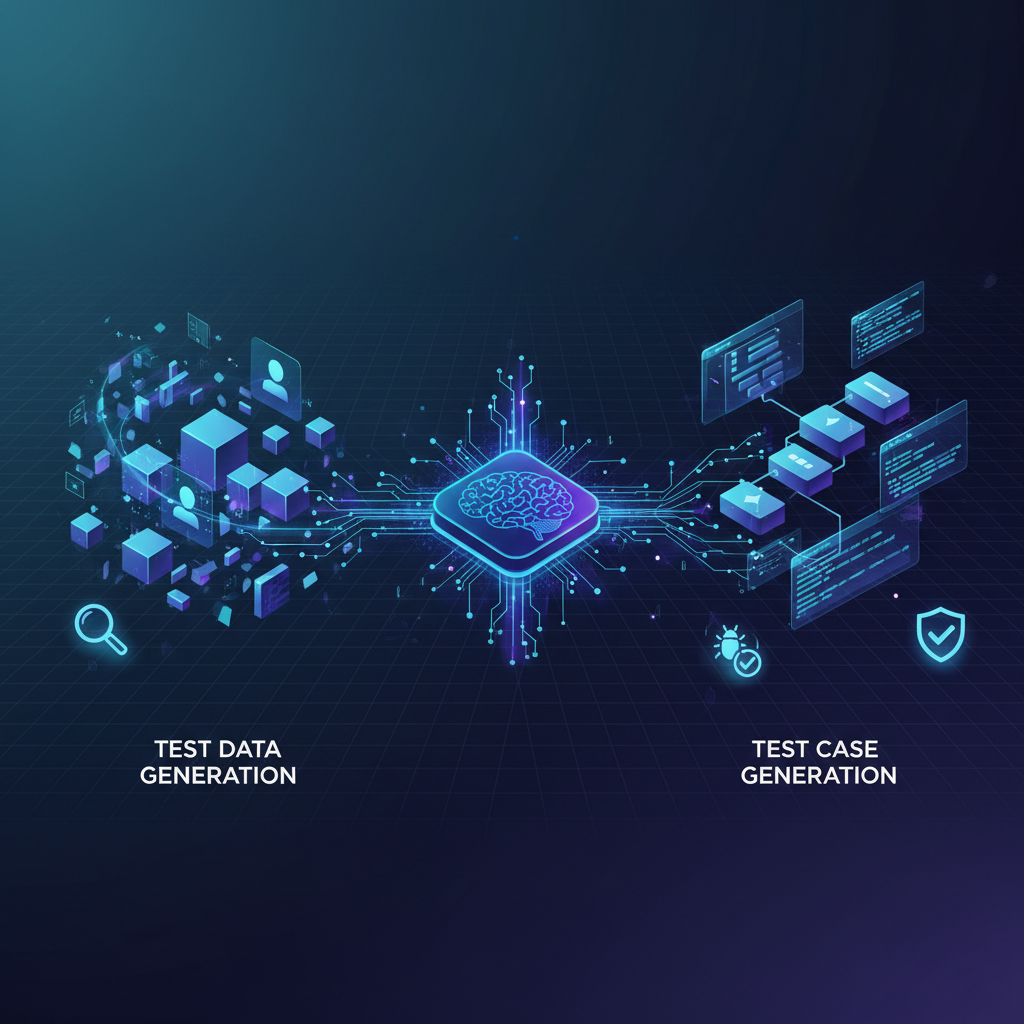
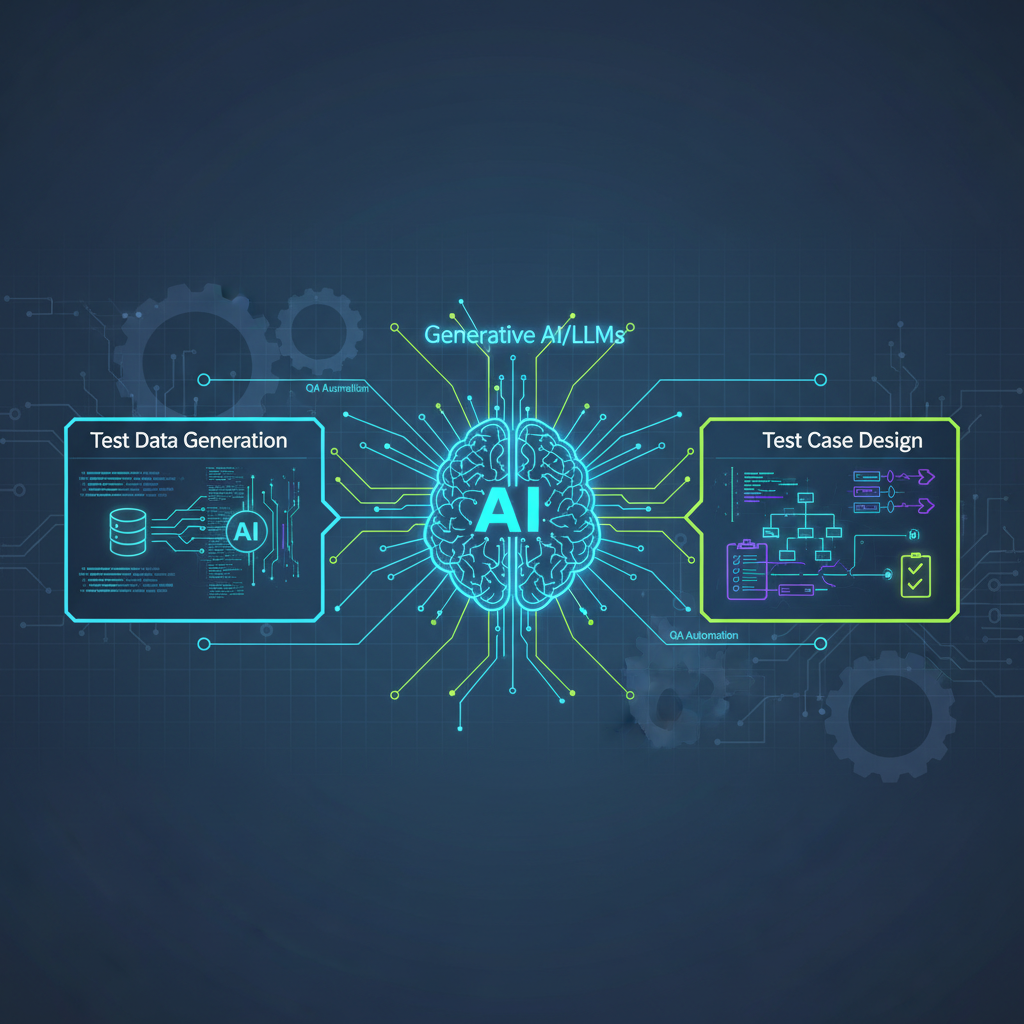
Discover how AI-powered generative test case and data generation is transforming software quality assurance. This paradigm shift leverages cutting-edge AI to automate the creation of diverse, effective test cases and realistic synthetic data, enhancing software robustness and reliability.
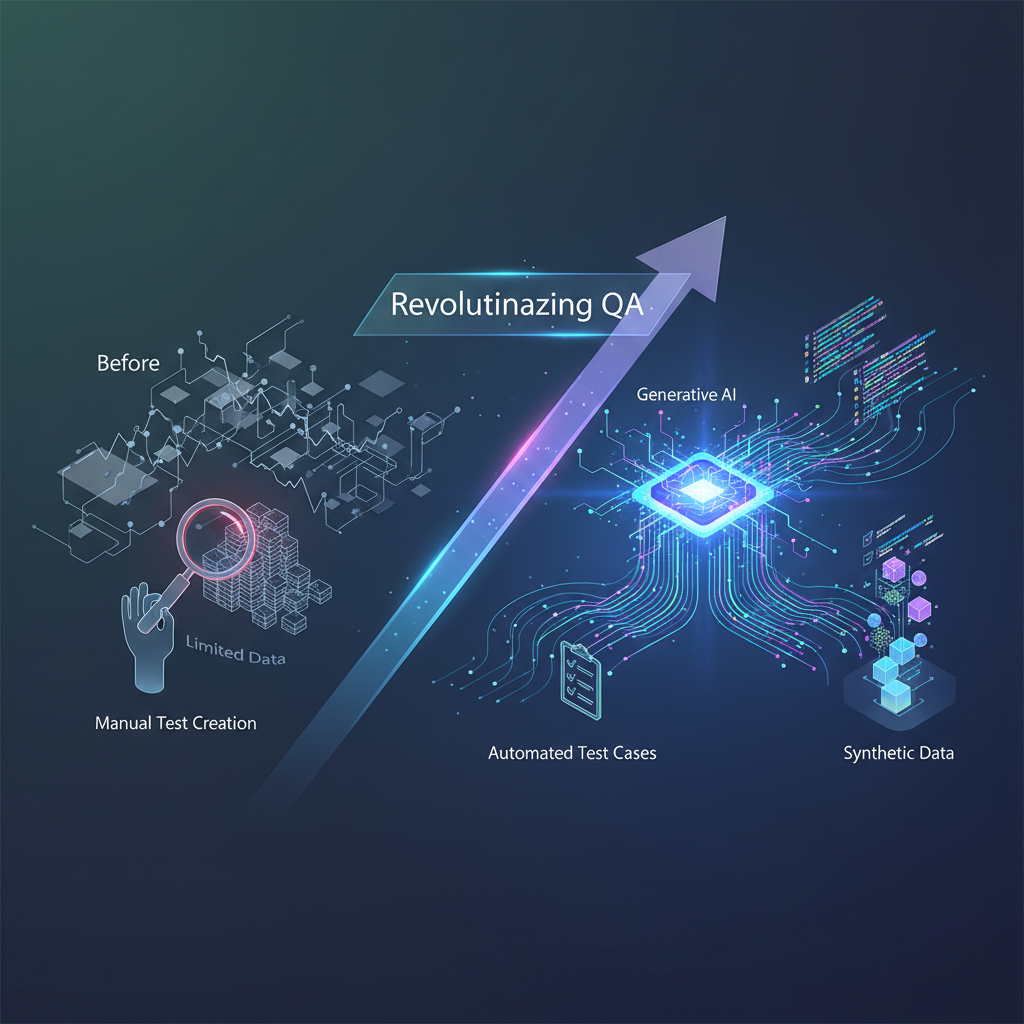
The landscape of software development is constantly evolving, with increasing complexity, faster release cycles, and an ever-growing demand for flawless user experiences. In this high-stakes environment, traditional quality assurance (QA) and quality control (QC) methodologies often struggle to keep pace. Manual test case creation is time-consuming and error-prone, while even automated frameworks require significant human effort to script and maintain.
However, a revolutionary shift is underway, powered by artificial intelligence. The emergence of AI-powered generative test case and data generation is poised to transform how we approach software quality, offering unprecedented efficiency, coverage, and realism in testing. This isn't just an incremental improvement; it's a paradigm shift that leverages cutting-edge AI techniques to automatically create diverse, effective test cases and synthetic data, fundamentally enhancing the robustness and reliability of our software systems.
The Imperative for Generative AI in QA
Why is this field gaining such traction now? Several converging factors highlight its timeliness and critical importance:
- The LLM Explosion: The recent breakthroughs and widespread accessibility of Large Language Models (LLMs) like GPT-3.5/4, LLaMA, and their open-source counterparts have unlocked new possibilities. LLMs can now interpret natural language requirements and translate them into structured test scenarios and even executable code, making test creation more intuitive and powerful than ever before.
- Complexity of Modern Systems: Today's software architectures—microservices, distributed systems, highly interactive UIs, and even AI/ML models themselves—present an enormous, often intractable, state space for traditional testing methods. Generative AI offers a path to explore these complex systems more effectively, uncovering hidden bugs and edge cases.
- Data Scarcity and Privacy: Generating realistic test data is a perennial challenge. Real production data is often sensitive and subject to stringent privacy regulations (e.g., GDPR, CCPA), making its direct use in testing problematic. Generative AI provides a solution by creating synthetic data that mimics the statistical properties of real data without compromising privacy, while also enabling the generation of data for rare edge cases.
- Shift-Left Testing: The mantra of "shift-left" testing—catching bugs earlier in the development lifecycle when they are cheaper and easier to fix—is greatly facilitated by generative AI. Automating test creation early means defects can be identified and rectified before they propagate through the system.
- Democratization of Testing: By allowing developers, product managers, and even non-technical stakeholders to contribute to test creation through natural language descriptions, generative AI reduces the bottleneck often associated with specialized QA engineers, fostering a more collaborative approach to quality.
This confluence of factors makes AI-powered generative testing not just an interesting academic pursuit, but a vital practical necessity for modern software development.
Key Developments and Emerging Trends
The field is rapidly evolving, driven by advancements across various AI disciplines. Here's a closer look at the core techniques and their applications:
1. LLM-driven Test Case Generation from Requirements
At the forefront of this revolution are Large Language Models. Their ability to understand, interpret, and generate human-like text makes them ideal for transforming abstract requirements into concrete test scenarios.
Mechanism: LLMs are trained on vast corpora of code, documentation, test cases, and natural language. When provided with inputs such as user stories, functional specifications, design documents, or even UI mockups, they can generate:
- Detailed, human-readable test scenarios: Describing the steps, preconditions, and expected outcomes.
- Gherkin features: Using the Given-When-Then format, which is highly readable and directly usable by tools like Cucumber or SpecFlow.
- Executable test scripts: Code snippets for popular automation frameworks like Selenium, Playwright, Cypress, or even API testing tools like Postman collections.
Advancements:
- Fine-tuning: Organizations can fine-tune general-purpose LLMs on their specific codebase, internal documentation, existing test suites, and domain-specific language. This significantly improves the relevance, accuracy, and style of the generated tests.
- Prompt Engineering: Crafting effective prompts is crucial. By providing clear instructions, examples, and constraints, testers can guide the LLM to generate more precise and comprehensive tests. Techniques like few-shot learning (providing a few examples in the prompt) or chain-of-thought prompting (asking the LLM to reason step-by-step) are particularly effective.
- Integration with IDEs and CI/CD: Tools are emerging that integrate LLM-based test generation directly into Integrated Development Environments (IDEs) and Continuous Integration/Continuous Deployment (CI/CD) pipelines, making it a seamless part of the development workflow.
Practical Example: Imagine a user story: "As a registered user, I want to be able to reset my password using my registered email address so that I can regain access to my account if I forget my password."
An LLM, given this prompt and perhaps some context about the application's authentication flow, could generate:
Feature: Password Reset Functionality

  Scenario: Successful password reset with valid email
    Given I am on the "Forgot Password" page
    And I enter my registered email "[email protected]"
    When I click the "Send Reset Link" button
    Then I should see a message "Password reset link sent to your email."
    And an email with a reset link should be sent to "[email protected]"
    When I open the email and click the reset link
    Then I should be redirected to the "Reset Password" page
    And I enter a new password "NewSecurePass123!"
    And I confirm the new password "NewSecurePass123!"
    When I click the "Reset Password" button
    Then I should be redirected to the "Login" page
    And I should see a message "Password successfully updated. Please log in."
    And I should be able to log in with "[email protected]" and "NewSecurePass123!"

  Scenario: Password reset with unregistered email
    Given I am on the "Forgot Password" page
    And I enter an unregistered email "[email protected]"
    When I click the "Send Reset Link" button
    Then I should see an error message "Email address not found."
    And no email should be sent to "[email protected]"

  Scenario: Password reset with invalid email format
    Given I am on the "Forgot Password" page
    And I enter an invalid email format "invalid-email"
    When I click the "Send Reset Link" button
    Then I should see an error message "Please enter a valid email address."

  Scenario: Password reset link expiration
    Given I am on the "Forgot Password" page
    And I enter my registered email "[email protected]"
    When I click the "Send Reset Link" button
    And I wait for the reset link to expire (e.g., 15 minutes)
    And I open the expired email and click the reset link
    Then I should be redirected to an "Error" page or "Link Expired" page
    And I should see a message "Password reset link has expired."
Feature: Password Reset Functionality

  Scenario: Successful password reset with valid email
    Given I am on the "Forgot Password" page
    And I enter my registered email "[email protected]"
    When I click the "Send Reset Link" button
    Then I should see a message "Password reset link sent to your email."
    And an email with a reset link should be sent to "[email protected]"
    When I open the email and click the reset link
    Then I should be redirected to the "Reset Password" page
    And I enter a new password "NewSecurePass123!"
    And I confirm the new password "NewSecurePass123!"
    When I click the "Reset Password" button
    Then I should be redirected to the "Login" page
    And I should see a message "Password successfully updated. Please log in."
    And I should be able to log in with "[email protected]" and "NewSecurePass123!"

  Scenario: Password reset with unregistered email
    Given I am on the "Forgot Password" page
    And I enter an unregistered email "[email protected]"
    When I click the "Send Reset Link" button
    Then I should see an error message "Email address not found."
    And no email should be sent to "[email protected]"

  Scenario: Password reset with invalid email format
    Given I am on the "Forgot Password" page
    And I enter an invalid email format "invalid-email"
    When I click the "Send Reset Link" button
    Then I should see an error message "Please enter a valid email address."

  Scenario: Password reset link expiration
    Given I am on the "Forgot Password" page
    And I enter my registered email "[email protected]"
    When I click the "Send Reset Link" button
    And I wait for the reset link to expire (e.g., 15 minutes)
    And I open the expired email and click the reset link
    Then I should be redirected to an "Error" page or "Link Expired" page
    And I should see a message "Password reset link has expired."
This demonstrates how a single requirement can be expanded into multiple, distinct test cases covering various paths and error conditions, all generated automatically.
2. Synthetic Test Data Generation (GANs, VAEs, LLMs)
Generating realistic, diverse, and privacy-compliant test data is as critical as generating test cases. Generative AI offers powerful solutions here.
Mechanism:
- Generative Adversarial Networks (GANs) and Variational Autoencoders (VAEs): These deep learning models excel at learning the underlying distribution of real data and generating new samples that mimic its statistical properties. They are particularly effective for structured data (e.g., user profiles, financial transactions, sensor readings) and even unstructured data like images or complex time series.
- GANs: Consist of a generator network (creates synthetic data) and a discriminator network (tries to distinguish real from synthetic data). They train in an adversarial process until the generator can produce data indistinguishable from real data.
- VAEs: Learn a compressed, latent representation of the input data, from which new, similar data points can be sampled.
- LLMs: While GANs/VAEs handle numerical and complex structured data well, LLMs are unparalleled for generating realistic textual data. They can produce customer reviews, support tickets, email content, chat logs, or even code snippets based on specific prompts or patterns.
Advancements:
- Data Integrity and Referential Consistency: Advanced techniques focus on maintaining complex relationships and constraints across multiple tables or data sources, ensuring the generated data is internally consistent and valid.
- Edge Case Generation: Generative models can be guided to create data points that represent rare or boundary conditions, which are often critical for robust testing but scarce in real datasets.
- Privacy-Preserving Synthesis: By learning distributions without memorizing individual data points, these models can generate data that is statistically similar to sensitive production data but contains no identifiable information, ensuring compliance with regulations like GDPR or HIPAA.
Practical Application:
- Financial Services: Generating synthetic transaction data to test fraud detection systems, compliance reporting, or new financial products without using real customer data.
- Healthcare: Creating realistic patient records (demographics, diagnoses, treatments) for testing electronic health record (EHR) systems or medical AI models, while protecting patient privacy.
- E-commerce: Generating diverse customer profiles, order histories, and product reviews to test recommendation engines, search functionalities, or personalized marketing campaigns.
- Data Analytics and ML Pipelines: Providing voluminous and varied data to stress-test data ingestion, transformation, and model training pipelines, ensuring their robustness and scalability.
3. Reinforcement Learning (RL) for Test Path Exploration
While LLMs excel at generating tests from requirements, RL offers a dynamic approach to exploring the application under test (AUT) itself, discovering new paths and potential issues.
Mechanism: An RL agent interacts with the AUT as an environment.
- Actions: The agent performs actions like clicking buttons, typing text, navigating menus, or submitting forms.
- States: The agent observes the current state of the UI (e.g., page content, active elements).
- Rewards: The agent receives rewards for desirable outcomes (e.g., reaching a new page, covering a new code path, triggering an error, finding a crash). Negative rewards might be given for repetitive or unproductive actions. Over time, the agent learns an optimal policy to explore the application, maximizing its cumulative reward.
Advancements:
- Integration with Computer Vision and NLP: RL agents often combine with computer vision techniques (to recognize UI elements and their states) and natural language understanding (to interpret labels and context) to make more intelligent decisions about which actions to take.
- Goal-Oriented Exploration: Instead of purely random exploration, RL can be guided by specific testing goals, such as maximizing code coverage, reaching a particular deep state, or testing a specific feature.
- Adaptive Testing: The agent can adapt its exploration strategy based on feedback, focusing on areas where bugs are more likely to be found or where coverage is low.
Practical Application:
- Fuzz Testing: RL can generate unexpected inputs and sequences of actions to stress the application and uncover crashes or vulnerabilities.
- Exploratory Testing Automation: Mimicking human exploratory testing by intelligently navigating the UI, discovering new features, and identifying unexpected behaviors.
- Complex User Flows: Automatically testing intricate multi-step user journeys that are difficult to script manually.
- Performance Bottleneck Identification: Exploring different interaction patterns to identify scenarios that lead to performance degradation.
4. AI for Visual Regression Testing and UI Anomaly Detection
While not strictly "generative test cases," this related area uses AI to generate "expected" visual states, thereby automating a critical aspect of UI quality.
Mechanism: AI models, often Convolutional Neural Networks (CNNs), are trained to learn the normal visual appearance of UI components and entire pages.
- Baseline Generation: Instead of relying on manually approved screenshots, AI can learn from a set of "good" builds to establish a dynamic baseline of how the UI should look.
- Comparison and Anomaly Detection: When a new build is deployed, the AI compares current screenshots against these learned baselines or dynamically generated expected states. It flags visual discrepancies, layout shifts, missing elements, or rendering issues that deviate from the norm.
Advancements:
- Semantic Understanding: Moving beyond simple pixel-by-pixel comparisons, AI can understand the intent and context of UI elements. This reduces false positives from minor, intentional layout shifts (e.g., a button moving a few pixels due to responsive design) while still catching significant functional or aesthetic regressions.
- Cross-Browser/Device Consistency: AI can learn expected visual behavior across various browsers, operating systems, and device form factors, ensuring a consistent user experience without needing to write explicit visual assertions for every permutation.
- Self-Healing Visual Tests: Some systems can automatically update baselines for minor, approved UI changes, reducing maintenance overhead.
Practical Application:
- Ensuring Brand Consistency: Verifying that logos, color schemes, and typography remain consistent across an application.
- Responsive Design Validation: Automatically checking that UI elements adapt correctly to different screen sizes and orientations.
- Catching Unintended UI Changes: Identifying subtle visual regressions that human eyes might miss, such as misaligned elements, truncated text, or incorrect font rendering.
- Accessibility Testing: AI can be trained to detect common accessibility issues, such as low contrast ratios or missing alt text for images.
Practical Applications and Value for AI Practitioners
The impact of AI-powered generative testing extends across various roles within the software development ecosystem:
-
For Developers & SDETs (Software Development Engineers in Test):
- Accelerated Test Creation: Drastically reduces the manual effort and time spent writing boilerplate test code and defining test data, allowing them to focus on complex logic.
- Increased Coverage: AI can identify and generate tests for edge cases, boundary conditions, and complex scenarios that human testers might overlook, leading to more robust software.
- Improved Test Maintainability: AI can assist in updating tests when requirements, UI elements, or APIs change, reducing the burden of test suite maintenance.
- Focus on Higher-Value Activities: Frees up human testers to engage in more strategic tasks like exploratory testing, performance analysis, security auditing, and improving test infrastructure.
-
For AI/ML Engineers:
- Robust AI Model Testing: Generative AI can create diverse and adversarial datasets to test the robustness, fairness, and generalization capabilities of other AI/ML models, ensuring they perform reliably in real-world conditions.
- Model Validation: Ensures that AI models integrated into production systems behave as expected under various input conditions, identifying biases or unexpected outputs.
-
For Data Scientists:
- Synthetic Data for Training and Augmentation: Generate privacy-preserving synthetic data for training new models or augmenting existing datasets, especially in sensitive domains like healthcare or finance where real data is scarce or restricted.
- Data Quality Assurance: AI can generate data to validate data pipelines, ETL (Extract, Transform, Load) processes, and data quality rules, ensuring data integrity from source to destination.
-
For Business Stakeholders:
- Faster Time-to-Market: Quicker and more comprehensive testing leads to faster release cycles, allowing businesses to respond more rapidly to market demands.
- Higher Quality Software: Reduced defect rates, improved user experience, and increased customer satisfaction contribute directly to business success.
- Cost Savings: Lower defect rates in production, more efficient testing processes, and reduced manual effort translate into significant cost savings.
Challenges and Future Directions
While the promise of generative AI in QA is immense, several challenges need to be addressed:
- Hallucinations and Bias: Generative AI models can sometimes "hallucinate" incorrect or irrelevant test cases, or perpetuate biases present in their training data. Careful validation, human oversight, and robust feedback loops are crucial to mitigate these risks.
- Contextual Understanding: AI still struggles with deep business context, implicit requirements, and nuanced user behavior. Human guidance and refinement remain essential to ensure generated tests align with business goals.
- Integration Complexity: Integrating these advanced AI tools into existing CI/CD pipelines, test management systems, and development workflows can be complex, requiring significant engineering effort.
- Explainability: Understanding why an AI generated a particular test case, data point, or flagged an anomaly can be challenging. Improving the explainability of these AI systems is vital for debugging, building trust, and fostering adoption.
- Ethical Considerations: Ensuring synthetic data doesn't inadvertently leak sensitive patterns, create new biases, or enable malicious activities requires careful ethical consideration and robust governance.
- Performance and Scalability: Generating large volumes of complex test cases and data can be computationally intensive, requiring significant infrastructure and optimization.
Looking ahead, we can expect:
- Hybrid AI Approaches: Combining the strengths of different AI techniques (e.g., LLMs for high-level scenarios, RL for exploratory paths, GANs for data) to create more comprehensive and intelligent testing systems.
- Self-Healing Test Suites: AI systems that can automatically detect when tests become flaky or outdated and suggest or implement fixes.
- Proactive Bug Prediction: Leveraging AI to analyze code changes and predict where bugs are most likely to occur, guiding generative testing efforts.
- Domain-Specific AI Models: The development of highly specialized generative AI models fine-tuned for specific industries (e.g., finance, healthcare) or technologies (e.g., blockchain, IoT).
Conclusion
AI-powered generative test case and data generation is not merely an evolutionary step; it represents a fundamental transformation in how we assure software quality. By automating the often tedious, time-consuming, and error-prone aspects of test design and data provisioning, it empowers development teams to build more robust, reliable, and secure software at an unprecedented pace.
For AI practitioners, this field offers a fertile ground for applying cutting-edge research to solve real-world engineering challenges with tangible business impact. The convergence of advanced LLMs, sophisticated generative models, and intelligent reinforcement learning agents is pushing the boundaries of what's possible in QA. Embracing these technologies is no longer an option but a strategic imperative for any organization committed to delivering exceptional software quality in the age of increasing complexity and rapid innovation. The future of software quality is generative, and it's here now.