Generative AI: Revolutionizing Software Testing and QA Automation
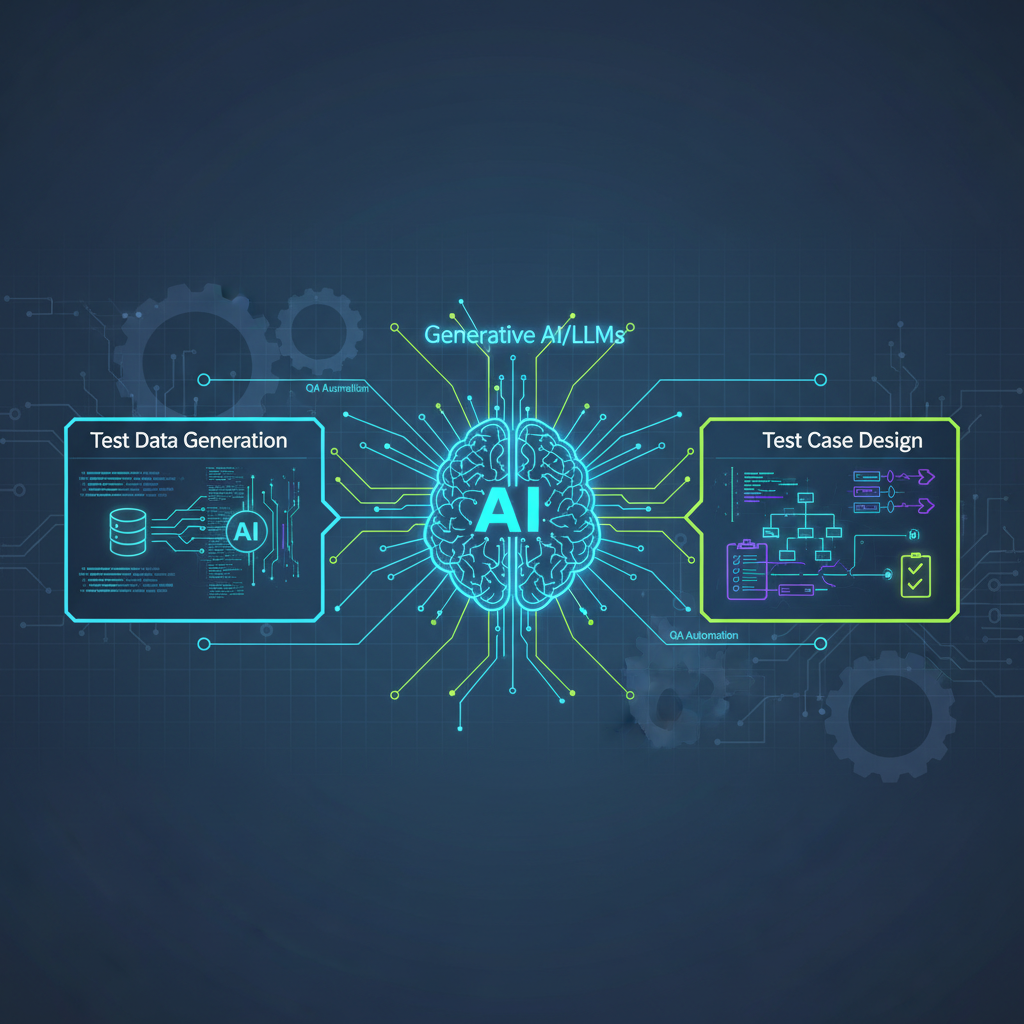
Explore how Generative AI, fueled by LLMs, is transforming software testing. Discover its potential to overcome bottlenecks in test data creation and test case design, fundamentally reshaping QA automation for unprecedented efficiency and coverage.
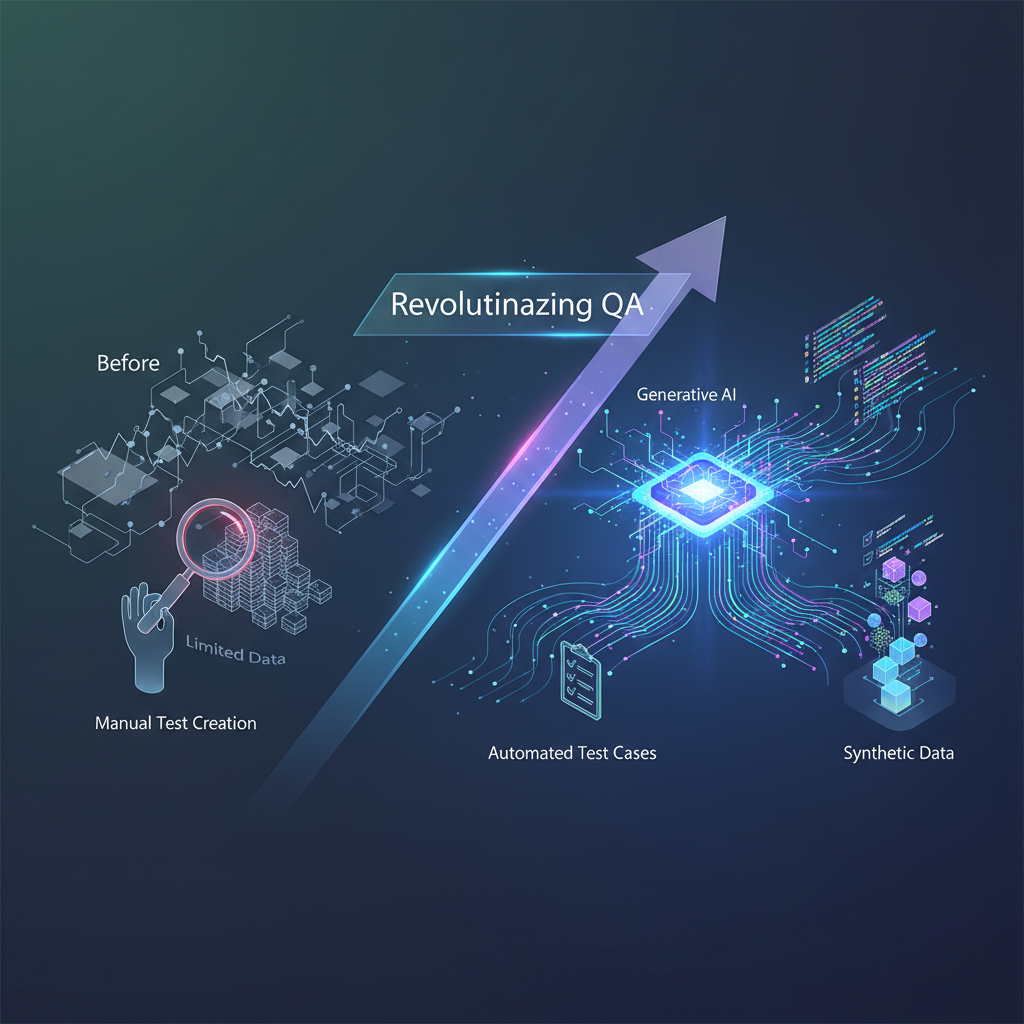
The software development landscape is a relentless race against time, complexity, and the ever-present threat of bugs. At the heart of delivering high-quality software lies robust testing, a discipline that, despite its critical importance, often grapples with significant bottlenecks. Two of the most persistent and costly challenges in software testing are the creation of realistic, diverse test data and the design of comprehensive test cases. Enter Generative AI – a transformative force poised to revolutionize how we approach Quality Assurance (QA) and Quality Control (QC) automation.
This rapidly evolving field, fueled by breakthroughs in Large Language Models (LLMs) and other generative techniques, promises to unlock unprecedented efficiency, coverage, and realism in testing. For AI practitioners and enthusiasts, understanding and leveraging generative AI in this domain isn't just about optimizing processes; it's about fundamentally reshaping the future of software quality.
The Enduring Pain Points in Software Testing
Before diving into the solutions, let's clearly articulate the problems that generative AI seeks to solve, problems that have plagued development teams for decades:
- Test Data Scarcity and Sensitivity: Production data, while ideal for testing, is often highly sensitive due to privacy regulations like GDPR, HIPAA, or CCPA. Using it directly in non-production environments is a compliance nightmare. Manually anonymizing or synthesizing data is a time-consuming, error-prone process that rarely achieves the diversity and realism of actual data, leading to incomplete test coverage.
- Test Case Design Complexity: Modern software systems are intricate, with countless interdependencies and potential interaction points. Manually crafting comprehensive test cases that cover functional requirements, non-functional attributes (performance, security), and elusive edge scenarios is a monumental task. Traditional methods like boundary value analysis or equivalence partitioning are foundational but can miss subtle, intricate interactions or novel failure modes that only emerge under specific, hard-to-imagine conditions.
- Maintenance Overhead: Software is never static. As systems evolve, requirements change, and new features are added, existing test data and test cases quickly become outdated. The effort required to update and maintain these artifacts constitutes a significant, ongoing cost and often becomes a bottleneck in release cycles.
- Lack of Realism in Synthetic Data: Historically, synthetically generated test data often falls short. It might lack the statistical properties, the subtle correlations between different data points, or the semantic nuances present in real-world data. This artificiality can limit its effectiveness in uncovering subtle bugs that only manifest under conditions mirroring genuine usage.
Generative AI: A Paradigm Shift for Test Data and Test Cases
Generative AI, particularly through the capabilities of LLMs and Generative Adversarial Networks (GANs), offers powerful, intelligent solutions to these long-standing problems.
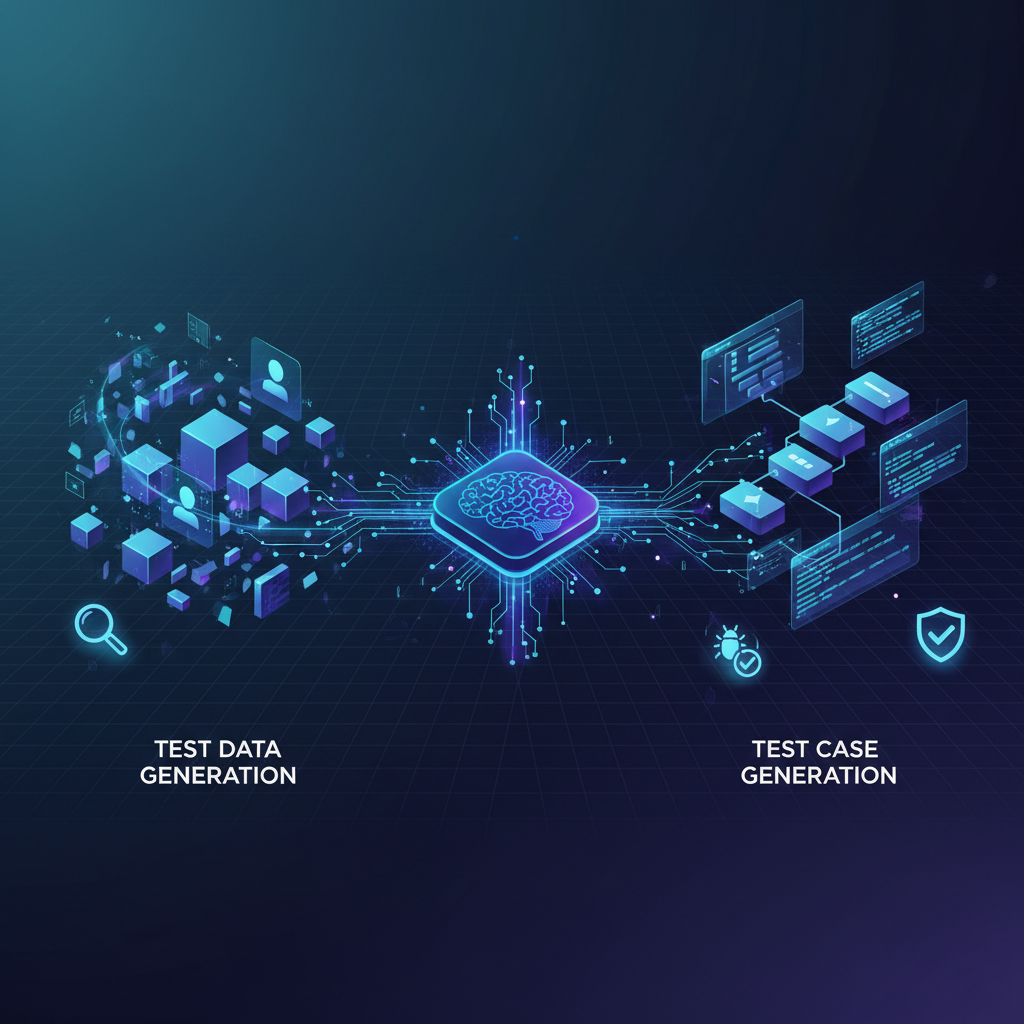
Test Data Synthesis: Beyond Anonymization
Generative AI moves beyond simple anonymization to create entirely new, yet statistically representative, data.
-
Large Language Models (LLMs) for Structured and Unstructured Data: LLMs excel at understanding and generating human-like text and structured data based on context, patterns, and instructions.
- How they work: Given natural language prompts, schema definitions (e.g., JSON, XML), or even a few examples, LLMs can generate diverse data. They can infer relationships and patterns from existing data to create new, realistic variations.
- Examples:
- Customer Profiles: "Generate 10 unique customer profiles for an e-commerce site, including names, email addresses, shipping addresses, and a list of 3 recent purchases, ensuring a mix of high-value and low-value customers."
- Product Descriptions: "Create 5 product descriptions for smart home devices, focusing on features, benefits, and technical specifications, varying the tone from formal to casual."
- Log Entries: "Synthesize 100 web server access log entries for a peak traffic hour, including various HTTP methods, status codes, and user agents, with some simulating error conditions."
- User Reviews: "Generate positive and negative user reviews for a mobile banking app, mentioning features like 'easy transfer' and 'slow loading times'."
- Underlying Mechanism: LLMs leverage their vast training data to understand the semantic and structural patterns of various data types. When prompted, they predict the most probable sequence of tokens (words, characters, or subwords) that fit the given criteria, effectively "creating" new data.
-
GANs and Variational Autoencoders (VAEs) for Statistical Fidelity: These models are particularly adept at learning the underlying distribution of complex datasets and generating new samples that adhere to that distribution.
- How they work:
- GANs: Consist of two neural networks, a generator and a discriminator, locked in a continuous game. The generator creates synthetic data, and the discriminator tries to distinguish it from real data. This adversarial process forces the generator to produce increasingly realistic data.
- VAEs: Learn a compressed, latent representation of the input data and then decode this representation to generate new samples. They are excellent for continuous data and provide a probabilistic framework for generation.
- Examples:
- Tabular Data: Generating synthetic financial transactions, patient records (anonymized), or sensor readings that maintain statistical correlations between columns (e.g., age, income, credit score).
- Time-Series Data: Creating realistic stock price movements, IoT sensor data, or network traffic patterns for performance testing.
- Image Data: Generating synthetic images for visual testing of UI components, or for training computer vision models without using sensitive real-world imagery.
- Key Advantage: They excel at preserving the statistical properties and complex correlations present in the original data, making the synthetic data highly realistic for analytical and testing purposes.
- How they work:
-
Differential Privacy Integration: A crucial aspect of responsible synthetic data generation. Differential privacy techniques can be integrated directly into generative models (e.g., by adding noise during training or generation) to provide mathematical guarantees that individual data points cannot be re-identified, even in the synthetic output. This ensures privacy while maintaining data utility.
Test Case Generation: From Requirements to Executable Scripts
Generative AI can significantly accelerate and enhance the creation of test cases, moving beyond manual interpretation of requirements.
- LLMs for Scenario and Step Generation: LLMs can act as intelligent assistants, analyzing various inputs to propose detailed test scenarios and step-by-step instructions.
- Input Analysis: They can ingest requirements documents (user stories, functional specifications), API documentation (OpenAPI/Swagger specs), or even existing codebases.
- Prompt Engineering: Testers can use high-level prompts to guide the generation:
- "Generate positive, negative, and edge test cases for a user login functionality, considering invalid credentials, locked accounts, and forgotten passwords."
- "Create API test cases for the
POST /orderendpoint based on its OpenAPI specification, including successful order creation, validation errors for missing fields, and authorization failures." - "Given this user story: 'As a registered user, I want to view my order history so I can track past purchases,' generate acceptance criteria and corresponding test scenarios."
- Code-based Generation: LLMs can go a step further and generate actual test code. This includes unit tests (e.g., Jest, JUnit), integration tests, or even end-to-end test scripts (e.g., Selenium, Playwright, Cypress) in various programming languages.
- Example Code Block:
python
# Prompt: Generate a Playwright test for a successful user login
# using username "testuser" and password "password123".

from playwright.sync_api import Page, expect

def test_successful_login(page: Page):
    page.goto("https://example.com/login")
    page.fill("#username", "testuser")
    page.fill("#password", "password123")
    page.click("#loginButton")
    expect(page.locator("#welcomeMessage")).to_have_text("Welcome, testuser!")
    expect(page).to_have_url("https://example.com/dashboard")
# Prompt: Generate a Playwright test for a successful user login # using username "testuser" and password "password123". from playwright.sync_api import Page, expect def test_successful_login(page: Page): page.goto("https://example.com/login") page.fill("#username", "testuser") page.fill("#password", "password123") page.click("#loginButton") expect(page.locator("#welcomeMessage")).to_have_text("Welcome, testuser!") expect(page).to_have_url("https://example.com/dashboard")
- Example Code Block:
- Exploratory Testing Augmentation: LLMs can suggest novel test ideas, "what-if" scenarios, or potential attack vectors that human testers might overlook, enriching the scope of exploratory testing.
- Test Oracles: In advanced scenarios, generative AI can assist in defining expected outcomes for complex systems where a deterministic oracle (a clear, pre-defined correct answer) is unavailable. This "soft oracle" capability can help validate system behavior against learned patterns or logical deductions.
Recent Developments and Emerging Trends
The field is experiencing rapid innovation, with several key trends shaping its future:
- Fine-tuning LLMs for Testing Domains: Companies are increasingly fine-tuning open-source LLMs (e.g., Llama, Mistral) or leveraging proprietary models (e.g., GPT-4, Gemini) with vast amounts of domain-specific testing data. This includes historical test cases, bug reports, requirements documents, and codebases, significantly improving the accuracy and relevance of generated test artifacts.
- Integration with Existing QA Tools: The power of generative AI is being brought directly to testers and developers through integrations with popular QA platforms, CI/CD pipelines (e.g., Jenkins, GitLab CI), and Integrated Development Environments (IDEs) like VS Code or IntelliJ IDEA. This makes AI-powered capabilities a seamless part of the development workflow.
- Synthetic Data as a Service (SDaaS): A new category of specialized platforms is emerging, offering on-demand synthetic data generation. These services often come with strong privacy guarantees, customizable data profiles, and the ability to generate data at scale, catering to diverse industry needs.
- Hybrid Approaches: The most effective solutions often combine generative AI with traditional testing techniques. For instance, using LLMs to generate initial test cases, then applying model-based testing or combinatorial testing to optimize coverage and identify critical paths.
- "Test Copilots": Similar to coding copilots, AI assistants are being developed to work alongside human testers. These "test copilots" suggest test cases, generate data on the fly, help debug failing tests, and even assist in writing test automation scripts in real-time, augmenting human capabilities rather than replacing them.
- Focus on Explainability and Control: As generative AI becomes more prevalent, there's a growing emphasis on making its outputs more transparent and controllable. Researchers are working on methods to allow testers to understand why a particular test case or data point was generated and to provide fine-grained control over the generation process, ensuring trust and reliability.
Practical Applications and Value for AI Practitioners
For AI practitioners, this domain offers a fertile ground for innovation and significant value creation:
- Reduced Time-to-Market: Automating test data and test case creation dramatically accelerates the testing phase, enabling faster software releases and quicker time-to-market for new features.
- Improved Test Coverage: AI's ability to identify and generate test cases for obscure edge cases and complex scenarios, which human testers might miss, leads to higher quality software and fewer production defects.
- Cost Savings: The automation of previously manual, labor-intensive tasks directly translates into reduced operational costs for QA teams.
- Enhanced Privacy and Security: By eliminating the need to use sensitive production data in non-production environments, synthetic data generation significantly reduces privacy risks and simplifies compliance with stringent data protection regulations.
- Scalability: Generative AI can produce vast quantities of diverse test data and test cases on demand, which is crucial for testing large-scale systems, microservices architectures, and applications with rapidly growing user bases.
- Democratization of Testing: By lowering the barrier to entry for generating sophisticated tests, generative AI can empower developers to take on more testing responsibilities, fostering a "shift-left" testing culture.
- New Roles and Skills: AI practitioners can specialize in prompt engineering for testing, fine-tuning generative models for specific test domains, or building custom generative AI solutions tailored to the unique needs of QA teams. This opens up exciting career paths at the intersection of AI and software quality.
Challenges and Future Directions
While the promise is immense, several challenges need to be addressed:
- Hallucinations and Accuracy: Generative models, especially LLMs, can sometimes produce plausible but incorrect or nonsensical test cases or data. Robust validation, human oversight, and iterative refinement remain crucial to ensure the quality of generated artifacts.
- Contextual Understanding: Ensuring the AI truly understands the intent behind complex requirements, the nuances of the system under test, and the implicit domain knowledge is a significant hurdle. This often requires more sophisticated prompts, fine-tuning, or integration with knowledge graphs.
- Bias in Training Data: If the generative model's training data contains biases (e.g., skewed demographic data, historical discriminatory patterns), the synthetic data or test cases generated will reflect and perpetuate those biases, potentially leading to missed bugs for underrepresented groups or unfair outcomes. Mitigating bias is a critical area of research.
- Evaluation Metrics: Developing robust, quantitative metrics to evaluate the quality, diversity, realism, and effectiveness of AI-generated test data and test cases is an ongoing challenge. How do we measure if a synthetic dataset is "good enough" to find bugs?
- Integration Complexity: Seamlessly integrating generative AI capabilities into diverse, often legacy, QA toolchains and CI/CD pipelines can be complex and requires careful architectural planning.
- Ethical Considerations: Beyond privacy, there are broader ethical considerations, especially when generative AI is used to simulate human behavior or generate data that could inadvertently be used for harmful purposes. Responsible AI development and deployment are paramount.
Conclusion
Generative AI for test data synthesis and test case generation is not merely an academic pursuit; it's rapidly transitioning into a practical necessity for modern software development. It offers a compelling vision for overcoming some of the most entrenched challenges in QA, promising faster releases, higher quality software, and reduced costs.
For AI practitioners and enthusiasts, this field presents a rich landscape for innovation. From developing more sophisticated generative models that can understand complex system behaviors to designing intelligent agents that can autonomously test intricate systems, the opportunities are boundless. Mastering prompt engineering, understanding the strengths and limitations of different generative architectures (LLMs, GANs, VAEs), and focusing on robust validation and human-in-the-loop control will be the key skills that define success in this exciting and impactful domain. The future of software quality is undeniably generative.