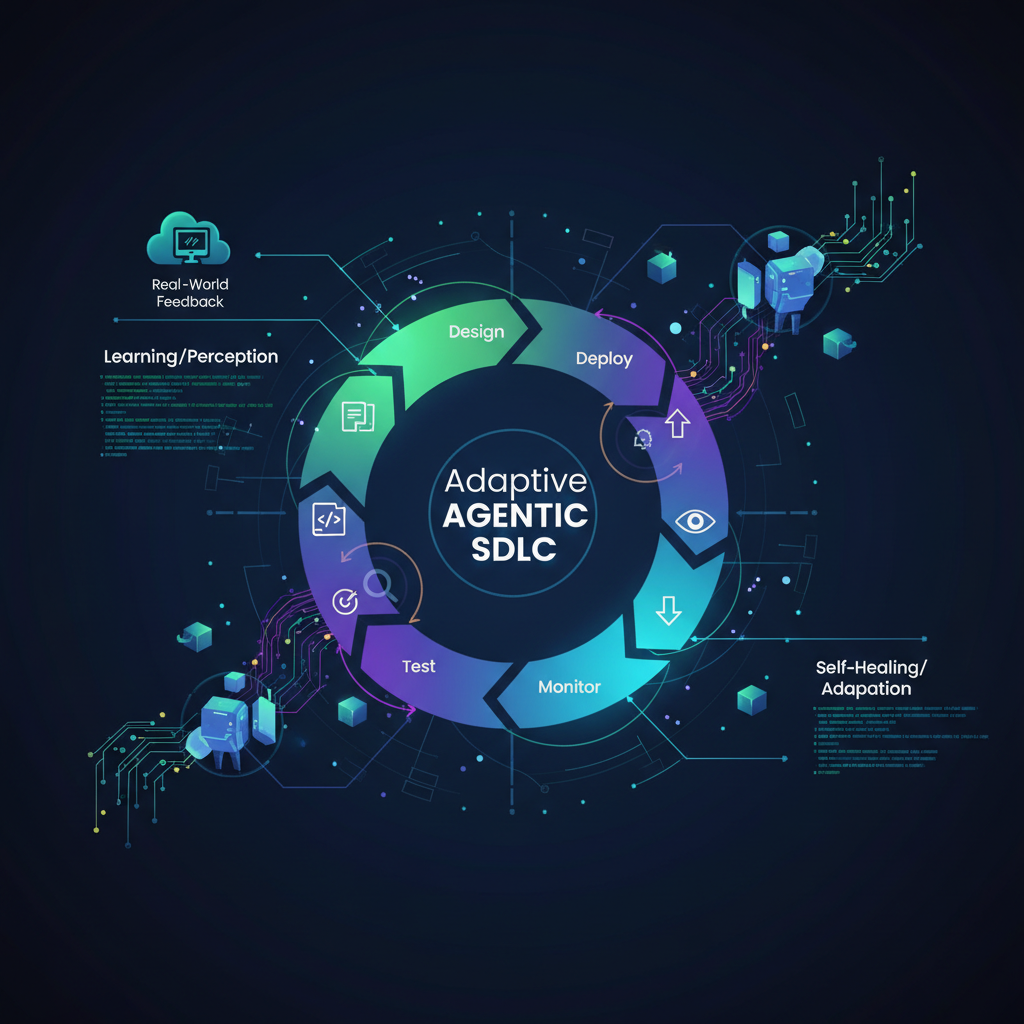
Human-in-the-Loop AI Agents: The Future of Complex Software Development
Discover how Human-in-the-Loop (HITL) agentic SDLC is revolutionizing software development for complex, evolving systems. This hybrid approach combines AI's power with human expertise to tackle modern challenges.
The dream of fully autonomous AI agents building software from scratch has long captivated the tech world. While that future inches closer, the most impactful and immediately practical revolution in software development isn isn't full autonomy, but rather a sophisticated partnership: Human-in-the-Loop (HITL) Agentic SDLC for Complex, Evolving Systems. This hybrid approach leverages the best of both worlds, transforming how we tackle the intricate challenges of modern software development.
The Imperative for Hybrid Human-Agent Workflows
Traditional software development lifecycles (SDLCs) are often challenged by the sheer complexity and rapid evolution of today's systems. Enterprise applications, distributed architectures, systems under stringent regulatory compliance, and those demanding deep domain expertise often push the limits of human capacity. Add to this the constant flux of changing requirements, emerging technologies, and ongoing maintenance, and the need for a more adaptive and efficient approach becomes clear.
This is where HITL Agentic SDLC shines. Instead of replacing humans, AI agents act as intelligent collaborators, augmenting human capabilities and streamlining workflows. The focus shifts from agents as mere code generators to sophisticated partners embedded within a human-centric development process.
Recent Developments and Emerging Trends in HITL Agentic SDLC
The field is rapidly evolving, moving beyond simplistic agent roles to more nuanced, integrated systems. Several key trends underscore this shift:
1. Multi-Agent Orchestration with Specialized Roles
The days of a single "coder" agent are giving way to sophisticated multi-agent teams. Imagine an SDLC powered by a collective of AI agents, each with a specialized role:
- Product Manager Agent: Interprets high-level requirements, clarifies ambiguities, and helps define user stories.
- Architect Agent: Designs system components, proposes architectural patterns, and ensures scalability and maintainability.
- Coder Agent: Generates code snippets, implements features, and adheres to coding standards.
- QA Agent: Writes test cases, performs automated testing, and identifies bugs.
- DevOps Agent: Manages infrastructure as code, automates deployments, and monitors system health.
Technical Details: Frameworks like AutoGen and CrewAI are at the forefront of enabling such orchestrations. They provide mechanisms for agents to communicate, delegate tasks, and resolve conflicts. For instance, a "Product Manager" agent might generate initial requirements, which are then passed to an "Architect" agent. The architect might then debate with a "Coder" agent about the feasibility of a design choice, with a human intervening to resolve impasses or provide critical domain context.
HITL Angle: Humans define the overarching project goals, oversee the initial planning stages, and critically review key artifacts like architectural blueprints or comprehensive test plans. When agents encounter a deadlock or a decision requiring nuanced judgment, human intervention provides the necessary guidance.
2. Adaptive and Self-Correcting Agents with Feedback Loops
Early agents were often "fire-and-forget," generating output without much introspection or learning. Modern agents are becoming more dynamic, capable of learning from their mistakes and incorporating external feedback.
Technical Details: This involves integrating several capabilities:
- Dynamic Introspection: Agents can analyze their own generated code or plans, identifying potential issues or areas for improvement.
- Automated Testing Integration: Agents can not only write tests but also execute them in sandboxed environments, using the test results as a direct feedback loop to refine their output.
- External Feedback Mechanisms: Structured feedback (e.g., specific error messages, linting reports) and unstructured feedback (natural language comments from human reviewers) are fed back into the agent's reasoning process.
HITL Angle: Humans provide explicit, actionable feedback. This could be as direct as "This design doesn't meet our security requirements" or "The performance of this function is unacceptable." Agents then use this feedback to iteratively refine their solutions, demonstrating a continuous learning cycle. This transforms human review from a final gate to an active, iterative coaching process.
3. Advanced Context Management and Knowledge Retrieval
Agents require more than just a brief prompt; they need access to a vast and dynamic pool of project-specific knowledge. This includes existing codebases, design documentation, internal API specifications, architectural patterns, and even historical decisions.
Technical Details: Retrieval Augmented Generation (RAG) systems are crucial here. These systems combine large language models (LLMs) with external knowledge bases. Vector databases store embeddings of project documentation, code snippets, and other relevant information. When an agent needs context, it queries the vector database to retrieve the most relevant pieces of information, which are then fed into the LLM as part of the prompt. Knowledge graphs can further enhance this by representing relationships between different pieces of information, allowing agents to infer deeper insights.
HITL Angle: Humans play a vital role in curating, maintaining, and updating these knowledge bases. They ensure the accuracy and completeness of the information, acting as guardians of institutional knowledge. When an agent struggles to find relevant information, a human can guide it to the correct sources or provide missing context, effectively "training" the RAG system in real-time.
4. Interactive Debugging and Refinement
The interaction model is shifting from agents delivering a complete, monolithic solution to agents engaging in an iterative, conversational refinement process with humans.
Technical Details: Integrated Development Environments (IDEs) are becoming central to this. Extensions and tools (like Cursor or specialized VS Code plugins) allow agents to suggest code, propose bug fixes, or refactor existing code directly within the developer's workspace. Humans can then approve, modify, or reject these suggestions. Agents can also execute code in sandboxed environments, report the results, and engage in a dialogue with the human about the next steps based on those results.
HITL Angle: Humans become "pair programmers" with agents. They guide the agent through debugging sessions, suggest alternative algorithms, or correct fundamental misunderstandings the agent might have about the problem domain. This real-time collaboration allows for rapid iteration and problem-solving.
5. Focus on Non-Code Artifacts
The scope of agentic SDLC is expanding beyond just generating executable code. Agents are increasingly capable of producing a wide array of critical development artifacts.
Technical Details: This involves training or prompting agents to adhere to specific industry standards, organizational templates, and compliance requirements for various document types. For example, an agent might generate a requirements document following the IEEE 830 standard, a design document adhering to a specific architectural pattern (e.g., microservices), or a user manual with specific formatting guidelines.
HITL Angle: Humans are indispensable for reviewing and approving these non-code artifacts. They ensure alignment with business objectives, regulatory mandates, and overall system architecture. This is where human domain expertise, critical thinking, and understanding of strategic goals are irreplaceable. An agent might generate a perfectly formatted design document, but only a human can truly assess if it meets the long-term vision or addresses subtle business constraints.
Practical Applications and Value for AI Practitioners and Enthusiasts
The tangible benefits of HITL Agentic SDLC are significant, offering value across various stages of the development lifecycle:
-
Accelerated Feature Development & Bug Fixing:
- Value: Agents can automate the creation of boilerplate code, generate initial feature drafts, or propose fixes for common bugs. This dramatically reduces the time developers spend on repetitive or less complex tasks.
- Practitioner Insight: Define clear, modular tasks for agents. Establish robust human review processes for agent-generated code, focusing on architectural integrity and critical logic.
-
Improved Code Quality & Consistency:
- Value: Agents, trained on best practices, coding standards, and security guidelines, can enforce consistency and elevate code quality. They can act as automated linters, static analyzers, and even security auditors.
- Practitioner Insight: While agents can flag issues, human oversight is crucial for complex architectural decisions, addressing novel security threats, or interpreting nuanced code smells.
-
Enhanced Documentation & Knowledge Management:
- Value: Agents can automatically generate or update documentation based on code changes, API specifications, or design updates. This combats "documentation debt," ensuring project knowledge remains current.
- Practitioner Insight: Humans still need to validate the accuracy, clarity, and completeness of agent-generated documentation, especially for critical user-facing or architectural documents.
-
Automated Testing & Test Case Generation:
- Value: Agents can generate comprehensive unit, integration, and even end-to-end test scenarios based on requirements or existing code. This is a massive time-saver.
- Practitioner Insight: Human review of test coverage and test effectiveness is non-negotiable, particularly for critical paths and edge cases that agents might miss.
-
Onboarding and Knowledge Transfer:
- Value: Agents can act as intelligent assistants, helping new team members understand complex codebases by generating explanations, summaries, or interactive walkthroughs.
- Practitioner Insight: This reduces the burden on senior developers for knowledge transfer, allowing them to focus on higher-level tasks while agents provide contextual support.
-
Addressing Technical Debt:
- Value: Agents can identify and suggest refactoring opportunities, update deprecated code, or assist in migrating older systems to newer frameworks, performing tedious but necessary work.
- Practitioner Insight: Human architects must approve refactoring strategies, especially those with significant architectural implications, to ensure they align with long-term system goals.
Challenges and Future Directions
While the promise of HITL Agentic SDLC is immense, several challenges remain:
- Trust and Explainability: How do we build sufficient trust in agent-generated code and designs? How can agents effectively explain their reasoning and decision-making processes to humans?
- Context Window Limitations: Despite advancements in RAG, managing the vast and dynamic context of large, evolving codebases remains a significant hurdle for current LLMs.
- Evaluating Agent Performance: Developing robust, standardized metrics and benchmarks to assess the quality, efficiency, and safety of agentic development outputs is critical.
- Security and Compliance: Ensuring agents adhere to stringent security protocols and regulatory requirements, especially in highly sensitive domains like finance or healthcare, is paramount.
- Human-Agent Interface Design: Creating intuitive and effective interfaces that facilitate seamless interaction, guidance, and oversight between humans and agent teams is an active area of research.
- Ethical Considerations: Addressing potential biases in generated code, navigating job displacement concerns, and establishing clear accountability for errors made by agents are crucial ethical considerations.
Conclusion
The frontier of Agentic SDLC is not about replacing human ingenuity with artificial intelligence, but rather about forging a powerful, synergistic partnership. Human-in-the-Loop Agentic SDLC represents the most practical and impactful path forward, particularly for the complex and ever-evolving systems that define modern technology. By intelligently integrating AI agents as collaborative partners, we can harness their speed and consistency while leveraging the irreplaceable strengths of humans: creativity, critical thinking, domain expertise, and ethical judgment. This hybrid approach promises to unlock unprecedented levels of efficiency, quality, and innovation in software development, ushering in a new era of human-AI collaboration.