Edge AI: Revolutionizing IoT with On-Device Intelligence
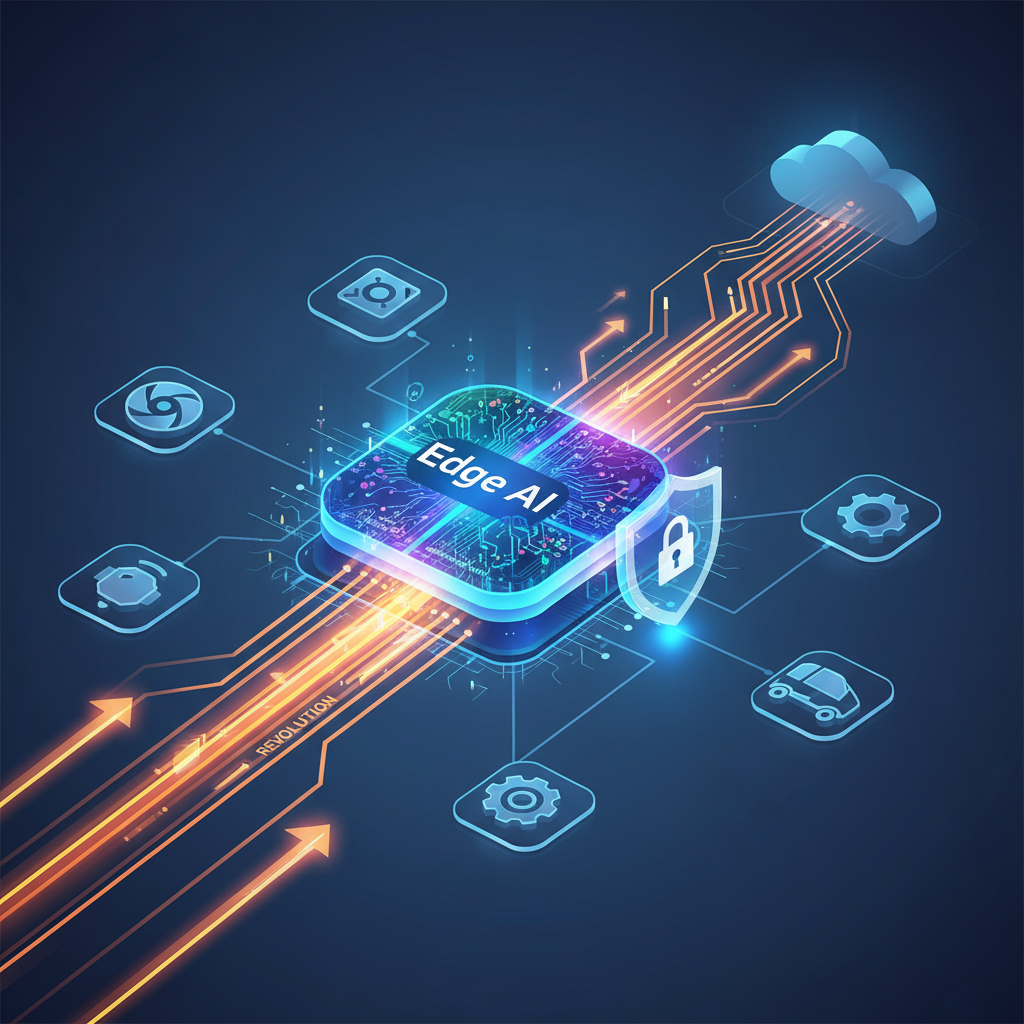
The Internet of Things (IoT) generates vast data, but traditional cloud AI struggles with bandwidth, latency, and privacy. Discover how Edge AI is transforming IoT by processing data closer to its source, unlocking new insights and automating processes efficiently.
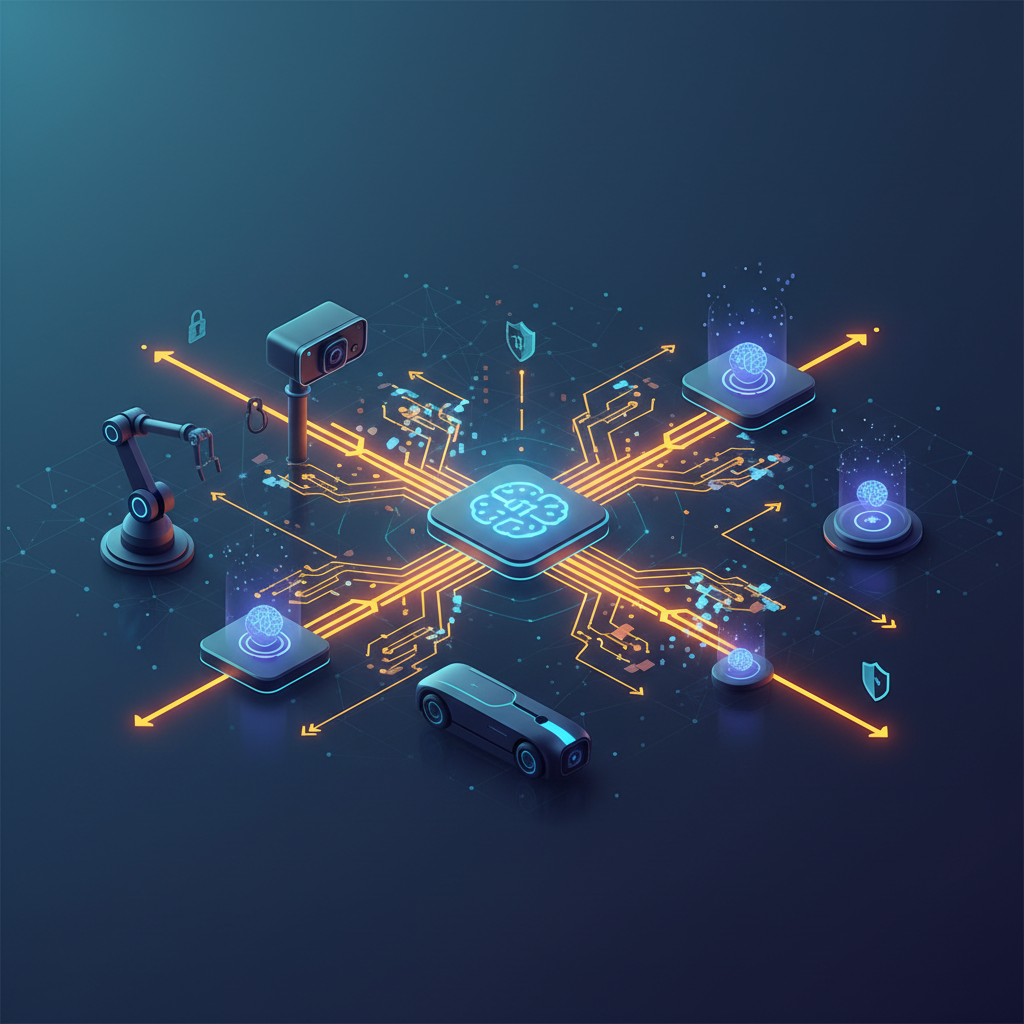
The digital world is expanding at an unprecedented rate, driven largely by the proliferation of the Internet of Things (IoT). Billions of devices, from smart sensors and wearables to industrial machinery and autonomous vehicles, are continuously generating a deluge of data at the "edge" of our networks. This data holds immense potential for unlocking new insights, automating processes, and personalizing experiences. However, harnessing this potential effectively and responsibly presents a formidable challenge.
Traditional cloud-centric Artificial Intelligence (AI) models, which rely on centralizing vast datasets for training, are increasingly hitting roadblocks in the IoT landscape. Imagine sending every heartbeat from a medical wearable, every frame from a smart city camera, or every sensor reading from a factory floor to a distant cloud server. This approach quickly becomes impractical due to bandwidth limitations, high latency, energy consumption, and, critically, profound data privacy concerns.
This is where Federated Learning (FL) steps in, offering a revolutionary paradigm shift. FL allows AI models to learn from distributed data residing on edge devices without ever requiring that sensitive raw data to leave its source. It's a game-changer for deploying intelligent systems in the resource-constrained, privacy-sensitive world of IoT.
The IoT Data Dilemma: Why Traditional AI Falls Short
Before diving into Federated Learning, let's unpack the core issues that make traditional cloud-based AI training ill-suited for many IoT applications:
- Data Privacy and Security: IoT devices often collect highly sensitive information – personal health data, location tracking, surveillance footage, proprietary industrial processes. Centralizing this data creates a massive honeypot for cyberattacks and raises significant ethical and regulatory concerns (e.g., GDPR, CCPA). Users and organizations are increasingly demanding stronger privacy guarantees.
- Communication Overhead and Latency: Uploading massive volumes of raw data from countless edge devices to a central cloud is bandwidth-intensive, slow, and expensive. For applications requiring real-time inference (like autonomous driving or industrial anomaly detection), the round-trip latency to the cloud is simply unacceptable.
- Energy Consumption: Constant data transmission, especially over cellular networks, is a major battery drain for resource-constrained edge devices. This limits device lifespan and increases operational costs.
- Heterogeneity of Edge Data (Non-IID): Data generated by different IoT devices or users often has varying distributions. For example, a smart home thermostat in a cold climate will collect different data patterns than one in a tropical region. A single global model trained on aggregated, diverse data might not perform optimally for any specific device or user.
- Resource Constraints of Edge Devices: While powerful, edge devices typically have limited computational power, memory, and battery life compared to cloud servers. This restricts the complexity of models they can run and the extent of local processing they can perform.
These challenges highlight the urgent need for a new approach to AI at the edge – one that respects privacy, conserves resources, and delivers intelligence where it's needed most.
Federated Learning: A Paradigm Shift for Edge AI
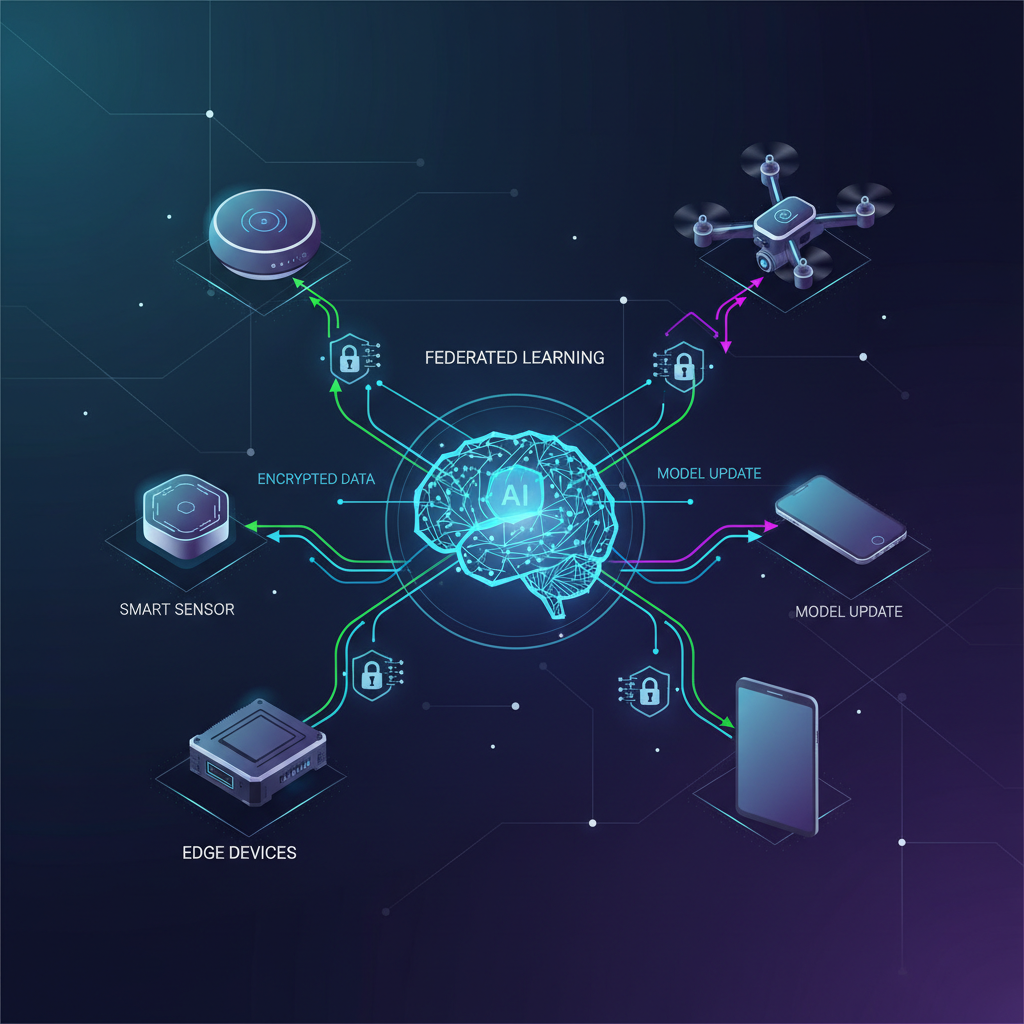
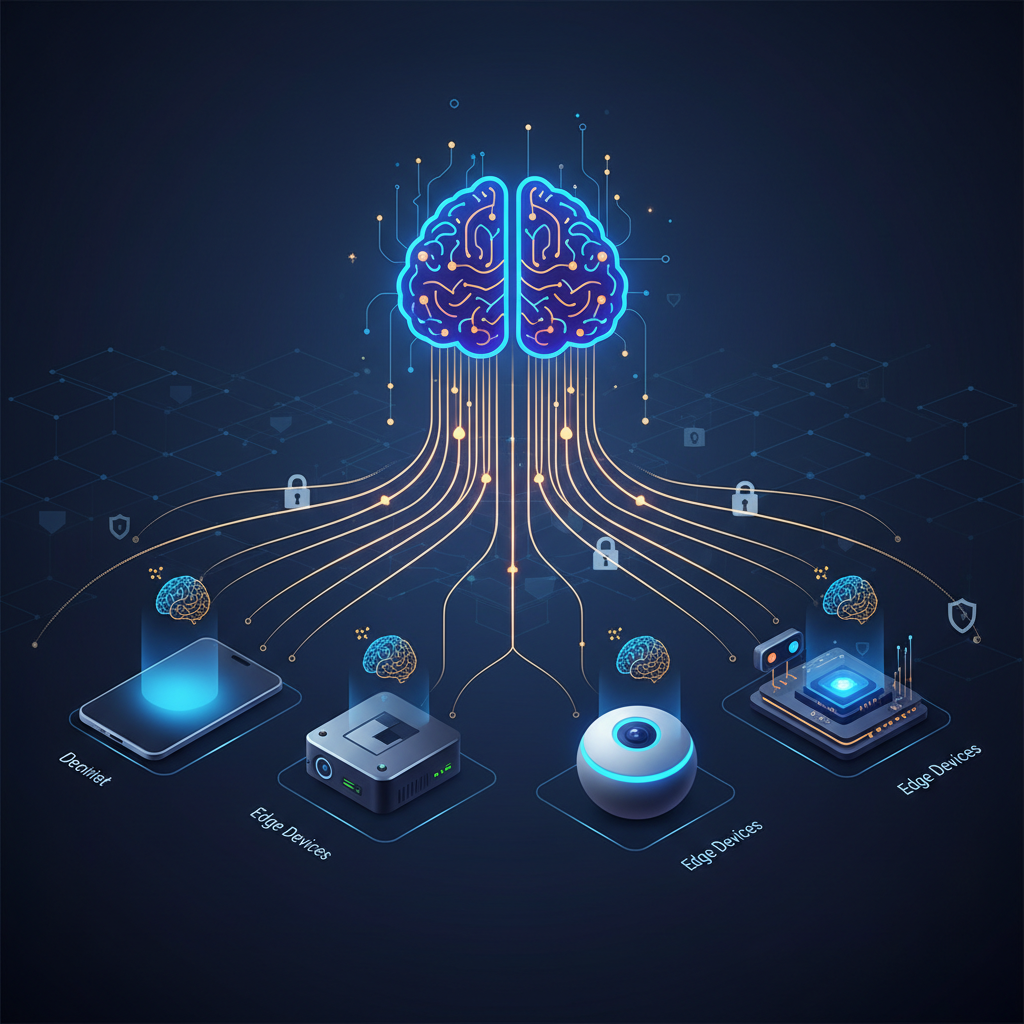
Federated Learning is a decentralized machine learning approach that enables multiple edge devices (clients) to collaboratively train a shared global model without exchanging their raw data. Instead of sending data to the cloud, FL reverses the process: the model comes to the data.
Here's a simplified breakdown of how it works:
- Global Model Initialization: A central server initializes a global machine learning model (e.g., a neural network) and sends it to a selected group of participating edge devices.
- Local Training: Each device downloads the global model and trains it locally on its own private dataset. During this phase, the device updates the model's parameters (e.g., weights and biases) based on its unique data. Critically, only the model updates are generated, not the raw data itself.
- Update Transmission: Once local training is complete, each device sends its updated model parameters (or gradients) back to the central server. These updates are typically much smaller than the raw data.
- Model Aggregation: The central server receives updates from multiple devices. It then aggregates these updates, often by averaging them, to create an improved version of the global model. This aggregation process synthesizes the learning from all participating devices.
- Iteration: The new, improved global model is then sent back to the devices for another round of local training, and the cycle continues until the model converges or a predefined number of rounds is reached.
This iterative process allows the global model to learn from the collective experience of all devices while ensuring that sensitive data never leaves the device's local environment.
Core Concepts and Recent Developments in FL for IoT
The field of Federated Learning is rapidly evolving, with active research addressing its inherent complexities, especially when applied to resource-constrained IoT environments.
1. Addressing Communication Efficiency
Communication is often the bottleneck in FL, particularly over unreliable or low-bandwidth IoT networks.
- Model Compression: Techniques like quantization (reducing the precision of model parameters, e.g., from 32-bit floats to 8-bit integers), pruning (removing less important connections or neurons), and sparsification (sending only a subset of updates) significantly reduce the size of transmitted model updates.
- Federated Averaging (FedAvg) Variants: FedAvg is the foundational aggregation algorithm. Variants like FedProx address challenges posed by non-IID data by adding a regularization term to local training, penalizing deviations from the global model. FedOpt explores adaptive optimization algorithms (like Adam or Adagrad) for server-side aggregation, which can accelerate convergence.
- Asynchronous FL: In synchronous FL, the server waits for all selected clients to respond before aggregating. Asynchronous FL allows devices to send updates at their own pace, improving robustness to device dropouts and varying computational capabilities, common in IoT.
- Client Selection Strategies: Intelligently choosing which devices participate in each training round can optimize efficiency. Strategies might consider devices with high-quality data, strong connectivity, sufficient battery life, or those that haven't participated recently to ensure fair representation.
2. Enhancing Data Privacy and Security
While FL inherently offers privacy benefits by keeping raw data local, model updates can still leak information. Advanced techniques further bolster privacy:
- Differential Privacy (DP): This technique adds carefully calibrated noise to the model updates before they are sent to the server. DP provides a mathematical guarantee that an individual's data cannot be inferred from the aggregated model, even if an adversary has access to all other data. The trade-off is often a slight reduction in model accuracy.
- Secure Multi-Party Computation (SMC): SMC allows multiple parties to jointly compute a function over their private inputs without revealing those inputs to each other. In FL, this can be used during the aggregation phase, where devices encrypt their updates, and the server aggregates them without ever seeing the individual unencrypted updates.
- Homomorphic Encryption (HE): HE is a powerful cryptographic technique that allows computations to be performed directly on encrypted data without decrypting it. This offers very strong privacy guarantees but comes with a significant computational overhead, making it challenging for real-time edge applications currently.
- Trusted Execution Environments (TEEs): Hardware-based solutions like Intel SGX or ARM TrustZone create isolated, secure areas within a device's processor. Local model training can occur within a TEE, protecting the model and data from even the device's own operating system or other software.
3. Tackling Resource Constraints of Edge Devices
IoT devices are often lean machines. FL needs to adapt to these limitations.
- Lightweight Model Architectures: Designing smaller, more efficient neural networks is crucial. Architectures like MobileNets and EfficientNets are specifically optimized for mobile and edge devices, offering good accuracy with significantly fewer parameters and computational requirements.
- On-Device Optimization: Techniques like knowledge distillation (training a smaller "student" model to mimic a larger "teacher" model) or progressive training (gradually increasing model complexity) can make local training more efficient.
- Energy-Aware FL: Research focuses on scheduling training rounds and communication to minimize energy consumption, for example, by training only when devices are charging or have sufficient battery.
4. Handling Data Heterogeneity (Non-IID Data)
The "independent and identically distributed" (IID) data assumption, common in traditional ML, rarely holds true in IoT.
- Personalized Federated Learning (PFL): Instead of aiming for a single global model that fits all, PFL seeks to learn personalized models for each client or groups of similar clients. This can involve training a global model as a starting point and then fine-tuning it locally, or learning a global representation that is then adapted to individual devices. This is vital for applications where user behavior or sensor characteristics vary widely.
- Meta-Learning for FL: Meta-learning (learning to learn) approaches can be used to quickly adapt a global model to individual client data, enabling rapid personalization without extensive local retraining.
Practical Applications and Use Cases
The power of Federated Learning in IoT is best illustrated through its diverse real-world applications:
- Smart Homes/Cities:
- Predictive Maintenance: Smart appliances or city infrastructure can collaboratively learn patterns of failure without sharing individual usage data, predicting maintenance needs more accurately.
- Personalized Energy Management: Home energy systems can optimize consumption based on collective learning of household habits while keeping individual energy usage private.
- Traffic Flow Optimization: Connected vehicles and sensors can collaboratively build models of traffic patterns to optimize routes and signal timing without sharing individual vehicle trajectories.
- Healthcare IoT:
- Remote Patient Monitoring: Wearable devices can collaboratively train models to detect anomalies or predict health events (e.g., heart attack risk, diabetic episodes) using private patient data, enabling personalized health recommendations without exposing sensitive medical records.
- Drug Discovery: Pharmaceutical companies can collaborate on training models using patient data from different hospitals without sharing the raw data, accelerating research while maintaining patient privacy.
- Industrial IoT (IIoT):
- Anomaly Detection: Machines on a factory floor can collaboratively learn what constitutes "normal" operation and detect anomalies, predicting equipment failures or quality control issues, without sharing proprietary operational data across different manufacturing plants.
- Predictive Maintenance: Similar to smart homes, industrial equipment can train models to predict component wear and tear.
- Autonomous Vehicles:
- Collaborative Perception: Vehicles can collaboratively improve their object detection and scene understanding models by sharing model updates, learning from diverse driving scenarios experienced by the fleet, without sharing raw sensor data (e.g., camera feeds, LiDAR scans).
- Driving Pattern Adaptation: Models can learn to adapt to local driving styles and road conditions while maintaining privacy.
- Smart Wearables:
- Personalized Fitness Tracking: Wearables can develop highly accurate activity recognition and calorie expenditure models tailored to individual users, leveraging collective learning while keeping personal health data private.
- Gesture Recognition: Improving gesture recognition models for smartwatches or AR/VR headsets by learning from diverse user interactions.
Value for AI Practitioners and Enthusiasts
For anyone passionate about AI, Federated Learning in IoT is more than just a buzzword; it's a frontier teeming with opportunities:
- Cutting-Edge Research: This domain is ripe with open problems in distributed optimization, privacy-preserving AI, robust model aggregation, and efficient deployment on heterogeneous hardware. Contributing here means shaping the future of AI.
- Practical Impact: Solutions developed in this space have immediate, tangible benefits for real-world IoT deployments, directly addressing critical concerns like privacy, scalability, and resource efficiency.
- Multidisciplinary Skills: Success in FL requires a blend of expertise: deep learning and machine learning fundamentals, distributed systems knowledge, cybersecurity and cryptography principles, and an understanding of embedded systems and edge computing.
- Emerging Tools & Frameworks: The ecosystem is growing rapidly with frameworks like TensorFlow Federated (TFF), PySyft (for privacy-preserving ML), and various custom FL platforms, offering exciting tools to explore and contribute to.
- Ethical AI Considerations: FL provides a direct pathway to implementing more ethical and privacy-respecting AI systems, aligning technological advancement with societal values.
Conclusion
Federated Learning for resource-constrained edge devices in IoT represents a pivotal shift in how AI is deployed and managed in the age of pervasive computing. It offers a compelling solution to the inherent tension between leveraging vast amounts of edge data for AI insights and safeguarding privacy, managing communication, and respecting device limitations. As IoT continues its explosive growth, FL will be instrumental in unlocking its full potential, enabling intelligent, privacy-preserving, and efficient AI systems that truly operate at the edge. For anyone interested in the future of AI, understanding and contributing to this field is not just valuable, but essential.