Federated Learning at the Edge: Revolutionizing AI for IoT Devices
Explore how Federated Learning (FL) is transforming AI for the Internet of Things (IoT). Discover how FL enables collaborative model training on edge devices, overcoming latency, bandwidth, and privacy challenges inherent in traditional cloud-centric AI.
The digital world is expanding at an unprecedented rate, driven largely by the proliferation of the Internet of Things (IoT). From smart home gadgets to industrial sensors and autonomous vehicles, billions of devices are now connected, generating vast oceans of data at the "edge" of our networks. This data holds immense potential for intelligence, but harnessing it effectively, especially with Artificial Intelligence (AI), presents significant challenges. Traditional cloud-centric AI models often fall short due to latency, bandwidth costs, and, critically, privacy concerns.
Enter Federated Learning (FL), a paradigm shift in machine learning that allows multiple entities to collaboratively train a shared prediction model while keeping all the training data localized on their own devices. When combined with the resource constraints inherent in many IoT edge devices, Federated Learning emerges as a powerful, timely, and practically relevant solution for bringing sophisticated AI capabilities directly to where the data is generated.
The Imperative for On-Device AI at the Edge
The vision of intelligent IoT devices performing complex tasks autonomously requires AI models to operate closer to the data source. This "Edge AI" offers several compelling advantages:
- Reduced Latency: Critical applications like autonomous driving or industrial control demand real-time responses. Processing data locally eliminates the round-trip time to a distant cloud server.
- Bandwidth Conservation: Sending raw sensor data from millions of devices to the cloud is economically and technically unfeasible. Edge AI processes data locally, sending only aggregated insights or model updates.
- Enhanced Reliability: Edge devices can continue to function intelligently even with intermittent or no network connectivity.
- Privacy and Security: Keeping sensitive data on the device significantly reduces the risk of data breaches and complies with stringent privacy regulations like GDPR and CCPA.
However, deploying sophisticated AI on IoT devices isn't straightforward. These devices are often characterized by:
- Limited Compute Power: Small CPUs, minimal or no GPUs, and restricted processing capabilities.
- Constrained Memory: Small RAM footprints and limited storage.
- Power Dependency: Many are battery-powered, requiring highly energy-efficient operations.
- Intermittent Connectivity: Often operate in environments with unreliable network access.
This is where Federated Learning shines. It provides a collaborative learning framework that respects these constraints while enabling powerful, privacy-preserving AI.
Federated Learning: A Collaborative, Privacy-Preserving Paradigm
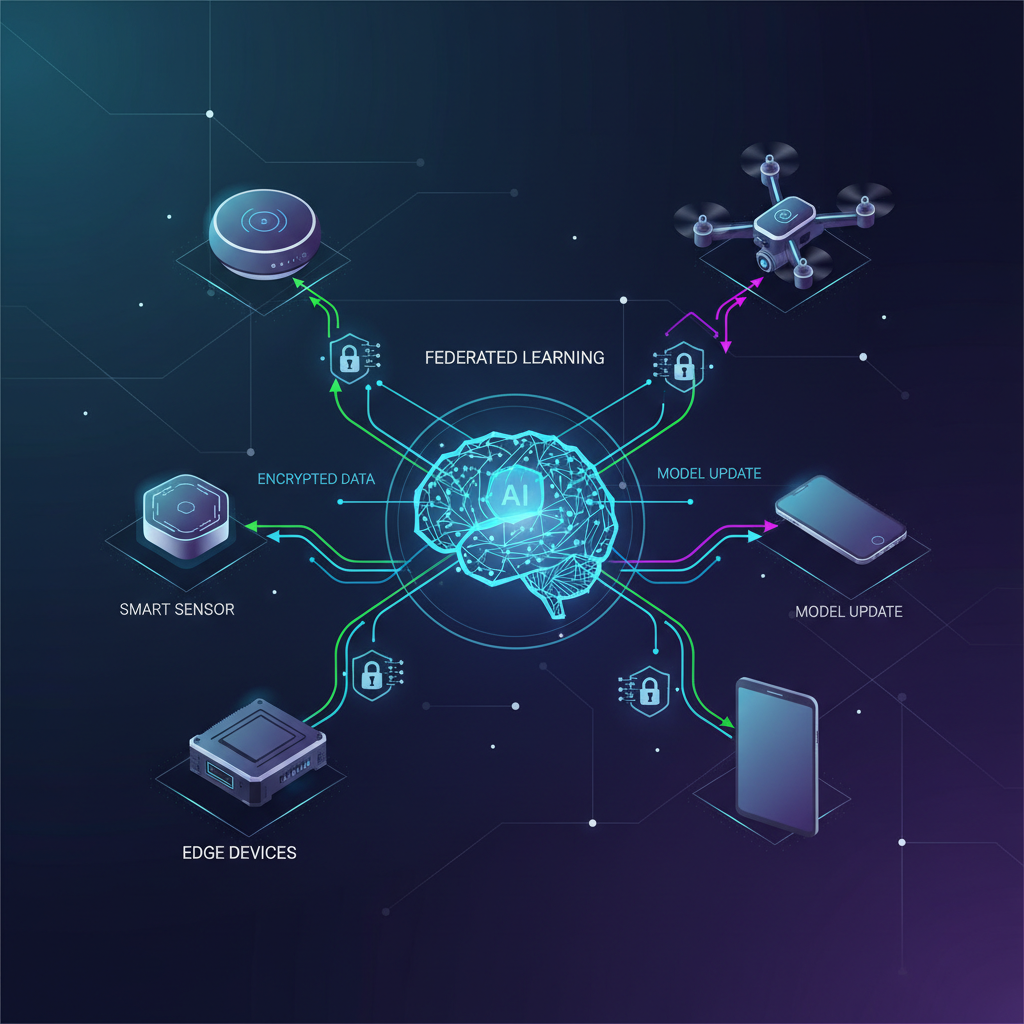
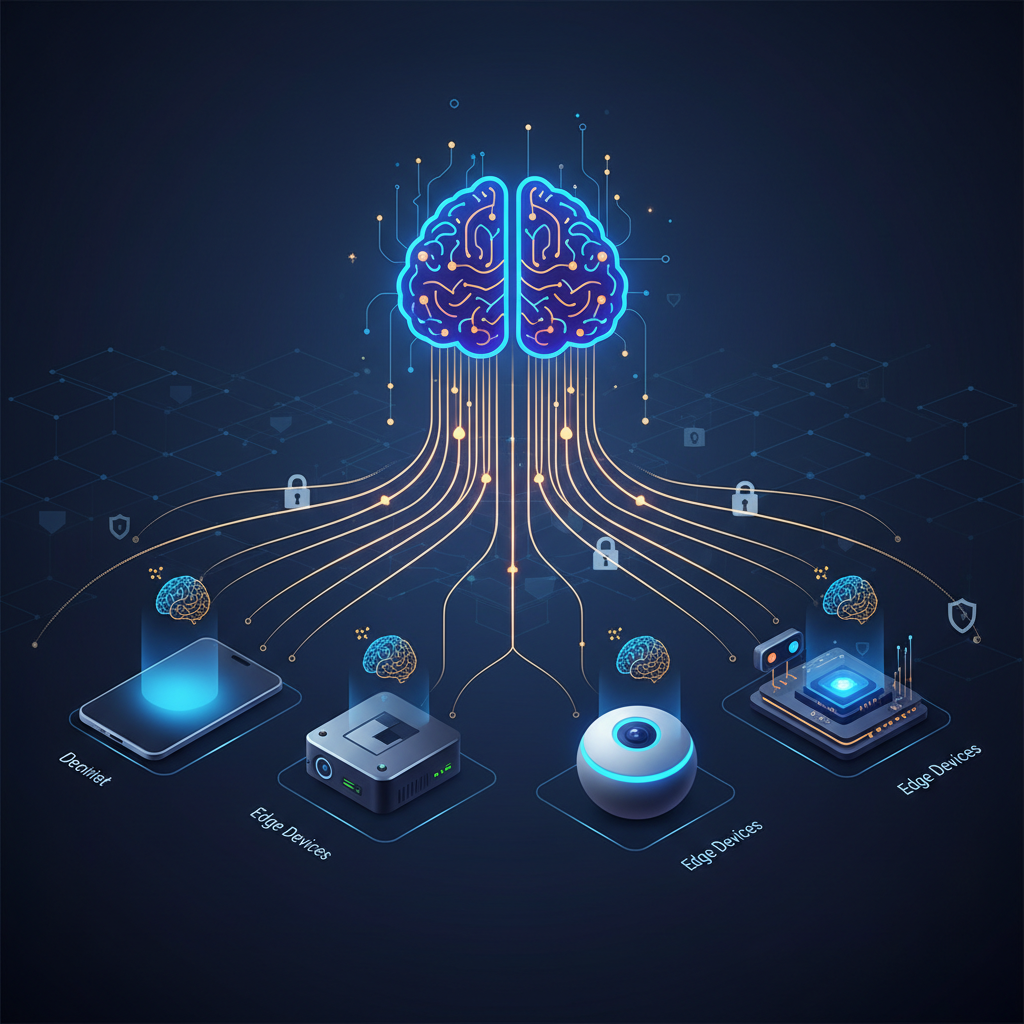
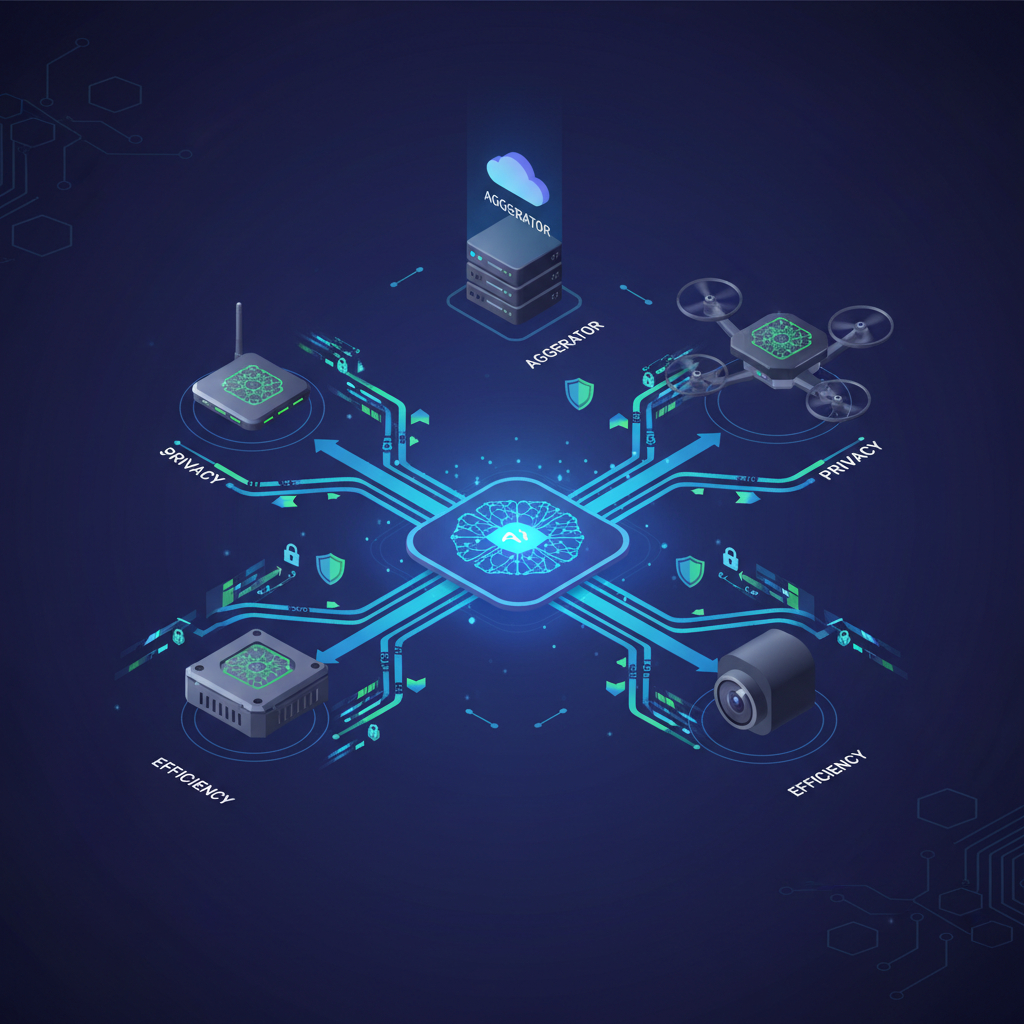
At its core, Federated Learning is a distributed machine learning approach. Instead of centralizing all data in a single server for model training, FL orchestrates a process where:
- A global model is initialized on a central server.
- This global model is sent to a subset of participating edge devices.
- Each device trains the model locally using its own private data.
- Only the model updates (e.g., gradients or weights differences), not the raw data, are sent back to the central server.
- The central server aggregates these updates to improve the global model.
- This process iterates, refining the global model over time.
The most common algorithm for this aggregation is Federated Averaging (FedAvg), proposed by Google. In FedAvg, devices train for a few local epochs, and then their updated model weights are averaged by the server.
Let's illustrate with a simplified example:
# Conceptual Python-like pseudocode for Federated Averaging

# Global Server
global_model_weights = initialize_model()

for round in range(num_communication_rounds):
    # 1. Server selects a subset of devices
    selected_devices = select_random_devices(all_devices, fraction_of_devices)

    # 2. Server sends current global model to selected devices
    device_updates = []
    for device in selected_devices:
        # 3. Each device trains locally
        local_model_weights = device.receive_model(global_model_weights)
        local_model_weights = device.train_locally(local_model_weights, device.local_data)

        # 4. Device sends model update (difference) back
        update = local_model_weights - global_model_weights
        device_updates.append(update)

    # 5. Server aggregates updates
    aggregated_update = average_updates(device_updates)
    global_model_weights += aggregated_update

    # Optional: Evaluate global_model_weights on a public test set
    evaluate_global_model(global_model_weights)

print("Federated training complete.")
# Conceptual Python-like pseudocode for Federated Averaging

# Global Server
global_model_weights = initialize_model()

for round in range(num_communication_rounds):
    # 1. Server selects a subset of devices
    selected_devices = select_random_devices(all_devices, fraction_of_devices)

    # 2. Server sends current global model to selected devices
    device_updates = []
    for device in selected_devices:
        # 3. Each device trains locally
        local_model_weights = device.receive_model(global_model_weights)
        local_model_weights = device.train_locally(local_model_weights, device.local_data)

        # 4. Device sends model update (difference) back
        update = local_model_weights - global_model_weights
        device_updates.append(update)

    # 5. Server aggregates updates
    aggregated_update = average_updates(device_updates)
    global_model_weights += aggregated_update

    # Optional: Evaluate global_model_weights on a public test set
    evaluate_global_model(global_model_weights)

print("Federated training complete.")
This approach inherently addresses privacy by design, as raw data never leaves the device. It also leverages the distributed compute power of the edge devices, making it scalable for massive IoT deployments.
Recent Developments and Emerging Trends
The field of Federated Learning is dynamic, with ongoing research addressing its inherent challenges and expanding its capabilities.
1. Communication Efficiency
The primary bottleneck in FL is the communication overhead. Sending model updates, especially for large deep learning models, can still consume significant bandwidth and energy. Researchers are tackling this through:
- Sparsification: Instead of sending all model parameters, devices send only the most significant changes (e.g., top-K gradients). This drastically reduces the data volume.
- Quantization: Reducing the precision of model parameters (e.g., from 32-bit floats to 8-bit integers or even binary) before transmission. This trades off a small amount of accuracy for substantial communication savings.
- Federated Averaging (FedAvg) Variants: Optimizing the aggregation process. For instance, FedProx addresses the challenge of non-IID (non-independently and identically distributed) data by adding a proximal term to the local objective function, ensuring local models don't drift too far from the global model. FedOpt and other adaptive optimization methods adjust learning rates dynamically for better convergence.
2. Personalization and Heterogeneity
IoT data is notoriously non-IID. A smart thermostat in a cold climate will have different data patterns than one in a warm climate. A single global model might not perform optimally for all devices. Emerging trends focus on:
- Personalized FL (pFL): Moving beyond a single global model to generate personalized models for each device or clusters of devices. Techniques like FedPer train a shared base model and then allow devices to fine-tune a personalized head layer. Meta-learning approaches also enable devices to quickly adapt the global model to their local data.
- Clustered FL: Grouping devices with similar data distributions and training separate models for each cluster, offering a balance between global generalization and local specialization.
3. Enhanced Security and Privacy
While FL is privacy-preserving by design, it's not entirely immune to privacy attacks (e.g., inference attacks that try to reconstruct training data from model updates). Advanced techniques are being integrated:
- Differential Privacy (DP): Adding carefully calibrated noise to model updates before transmission. This provides a formal, mathematical guarantee that an adversary cannot infer specific individual data points, even if they have access to all model updates.
- Secure Multi-Party Computation (SMC): Allows multiple parties to jointly compute a function over their inputs while keeping those inputs private. In FL, SMC can be used for secure aggregation, where the server aggregates model updates without seeing individual device contributions, only the final sum.
- Homomorphic Encryption (HE): A powerful cryptographic technique that allows computations to be performed directly on encrypted data. This means the central server can aggregate encrypted model updates without ever decrypting them, providing an extremely strong privacy guarantee. However, HE is computationally intensive and currently too slow for many real-time FL applications.
4. Hardware Acceleration for On-Device AI
The rise of specialized AI accelerators like Neural Processing Units (NPUs), Tensor Processing Units (TPUs), and custom ASICs (Application-Specific Integrated Circuits) is revolutionizing on-device AI. These low-power chips are designed for efficient inference and, increasingly, for on-device fine-tuning or training within FL contexts. This hardware enables more complex models to run efficiently on resource-constrained devices, pushing the boundaries of what's possible at the absolute edge.
5. Vertical Federated Learning
Traditional FL (often called Horizontal FL) assumes devices have the same feature space but different data samples (e.g., different users with similar smart home devices). Vertical FL addresses scenarios where different organizations have data about the same users but different feature sets. For example, a bank and an e-commerce site might have data on the same customer base but different aspects of their behavior. Vertical FL allows them to collaboratively build a richer model without sharing raw customer data, relevant for enterprise IoT scenarios involving multiple stakeholders.
6. Integration with TinyML
TinyML focuses on deploying machine learning models on extremely low-power, resource-constrained microcontrollers. Integrating FL with TinyML pushes AI capabilities to the absolute edge, enabling collaborative learning even on devices with kilobytes of RAM. This requires highly optimized models (e.g., pruning, quantization-aware training) and extremely efficient FL protocols designed for minimal communication and computation.
7. Federated Reinforcement Learning (FRL)
FRL applies FL principles to Reinforcement Learning (RL). In FRL, multiple agents (e.g., robots, smart traffic lights) learn from their local environments and share their learned policies or value functions with a central server. The server aggregates these learnings to build a more robust global policy, which is then distributed back to the agents. This is crucial for applications like swarm robotics, smart city traffic management, and industrial automation where agents need to learn from local interactions and benefit from collective intelligence.
Practical Applications for AI Practitioners and Enthusiasts
The theoretical advancements in Federated Learning translate into tangible, high-impact applications across various sectors.
Smart Home Devices
- Personalized Voice Assistants: Imagine your smart speaker learning your specific accent, vocabulary, and preferences for music or news, all without sending your voice recordings to the cloud. FL enables the device to fine-tune its acoustic and language models locally, sharing only generalized updates.
- Predictive Maintenance for Appliances: Washing machines or refrigerators can learn their own operational patterns (vibrations, power consumption) to predict potential failures. These local insights can be aggregated with similar devices to build a more robust global model for failure prediction, improving accuracy for all users while keeping individual appliance data private.
- Security Cameras: Smart cameras can improve their object detection capabilities (e.g., distinguishing pets from intruders, recognizing specific family members) by learning from local event data. Instead of uploading sensitive video feeds, only model updates are shared, enhancing both privacy and accuracy.
Healthcare IoT
- Wearable Health Monitors: Smartwatches and other wearables can train models to detect anomalies like irregular heartbeats, fall detection, or sleep apnea patterns directly on the device. FL allows these devices to collaboratively improve their diagnostic accuracy across a population, leveraging diverse physiological data without centralizing sensitive patient records.
- Remote Patient Monitoring: Hospitals or clinics can collaboratively train diagnostic models on aggregated, anonymized data from various patient monitoring devices. This allows for the development of more accurate disease prediction or treatment response models while strictly adhering to patient data privacy regulations (e.g., HIPAA).
Industrial IoT (IIoT)
- Predictive Maintenance for Machinery: In a factory setting, individual machines (e.g., CNC machines, turbines) can learn from their own sensor data (temperature, vibration, pressure) to predict component failures. FL enables these machines to share model updates, improving a global predictive model for similar machinery across different factories or even different companies, without revealing proprietary operational data.
- Quality Control: AI models on manufacturing lines can learn to detect defects in products. As new types of defects emerge or manufacturing processes change, these models can adapt locally and share updates, leading to a continuously improving quality control system across an entire production network.
Autonomous Vehicles & Robotics
- Collaborative Perception: Fleets of autonomous vehicles can collaboratively improve their perception models (e.g., for object recognition, lane detection, pedestrian classification). Each vehicle trains locally on its unique sensor data, then shares model updates. This allows the global model to learn from diverse road conditions, weather, and traffic scenarios encountered by the entire fleet, without sharing raw, privacy-sensitive sensor data or video.
- Fleet Learning for Robotics: A fleet of delivery robots or drones can collectively learn optimal navigation strategies, obstacle avoidance techniques, or task execution policies. As each robot explores its environment and performs tasks, it refines its local policy and shares updates, leading to a more efficient and robust collective intelligence for the entire fleet.
Smart Cities
- Traffic Management: Smart traffic light systems can learn optimal timing based on real-time local traffic flow and pedestrian data. These systems can then share model updates to improve city-wide traffic prediction and management, leading to reduced congestion and faster commute times.
- Environmental Monitoring: A network of environmental sensors can collaboratively train models to predict air quality, detect pollution hotspots, or forecast weather patterns. FL allows these sensors to leverage localized data for more accurate predictions without centralizing all environmental readings.
Conclusion: The Future is Federated and at the Edge
Federated Learning for on-device AI in resource-constrained IoT edge devices is not just a theoretical concept; it's a critical enabler for the next generation of intelligent systems. It addresses the fundamental tension between powerful AI capabilities and the growing demands for data privacy, efficient resource utilization, and real-time responsiveness.
For AI practitioners and enthusiasts, diving into this domain offers a unique opportunity to work on cutting-edge problems that blend machine learning, distributed systems, privacy engineering, and hardware optimization. It demands a holistic understanding of how AI models perform under real-world constraints and how collaborative intelligence can be fostered while respecting individual data sovereignty.
As the number of connected devices continues to skyrocket, and the regulatory landscape around data privacy tightens, Federated Learning will undoubtedly play a pivotal role in shaping how we deploy and scale AI, ensuring that intelligence is not just powerful, but also private, efficient, and truly ubiquitous. The future of AI is distributed, collaborative, and happening right at the edge.