Generative AI in QA: Revolutionizing Software Testing with Intelligent Data & Test Case Generation
Discover how Generative AI is transforming software testing by automating the creation of diverse, realistic test data and comprehensive test cases, addressing critical challenges in modern development.
The landscape of software development is in constant flux, driven by ever-increasing complexity, rapid release cycles, and the insatiable demand for quality. Traditional Quality Assurance (QA) and Quality Control (QC) methodologies, while foundational, often struggle to keep pace. The manual creation of diverse, realistic test data and comprehensive test cases has long been a bottleneck, consuming significant time, resources, and human effort. Enter Generative AI – a transformative force poised to revolutionize how we approach software testing.
At the cutting edge of AI-driven QA lies the powerful synergy of Generative AI for Intelligent Test Data Synthesis and Test Case Generation. This isn't just an academic pursuit; it's a practical imperative addressing critical challenges in modern software development, promising to elevate both the efficiency and efficacy of our testing efforts.
The Imperative for AI in QA: Why Now?
The timing for this technological convergence couldn't be more opportune, driven by several converging factors:
- The Generative AI Explosion: Recent breakthroughs in models like GPT-3/4, LLaMA, Stable Diffusion, and other generative architectures (GANs, VAEs) have demonstrated an unprecedented ability to create complex, human-like, or system-like data across various modalities. This capability is directly transferable to the needs of software testing.
- Navigating Data Scarcity and Privacy: Real-world production data is often a treasure trove of sensitive information (PII, HIPAA, GDPR, financial records). Using it directly for testing is a privacy nightmare and often legally prohibited. Furthermore, obtaining sufficient quantities of diverse, real-world data for comprehensive testing, especially for rare edge cases, can be incredibly challenging. Generative AI offers a robust solution: synthetic data that mimics real-world properties without compromising privacy.
- Complexity of Modern Systems: Today's software architectures—microservices, distributed systems, event-driven platforms, and AI/ML-driven applications—are inherently complex. Their state spaces are vast, interaction patterns intricate, and dependencies numerous. Manually crafting test data and test cases for such systems is not just expensive and time-consuming, but also highly prone to human error and oversight.
- The Shift-Left Mandate: The industry trend towards "shift-left" testing emphasizes finding and fixing bugs earlier in the development lifecycle, where they are significantly cheaper to remediate. Automating test data and test case generation empowers developers to test more thoroughly and frequently from the outset, embedding quality into the very fabric of development.
- Unlocking Cost and Time Efficiencies: Manual test data creation and test case design are notorious cost centers within software development projects. By automating these processes with AI, organizations can drastically reduce operational expenditures, accelerate testing cycles, and free up human testers to focus on more complex, exploratory, and value-added activities.
Core Concepts: Generative AI in Action
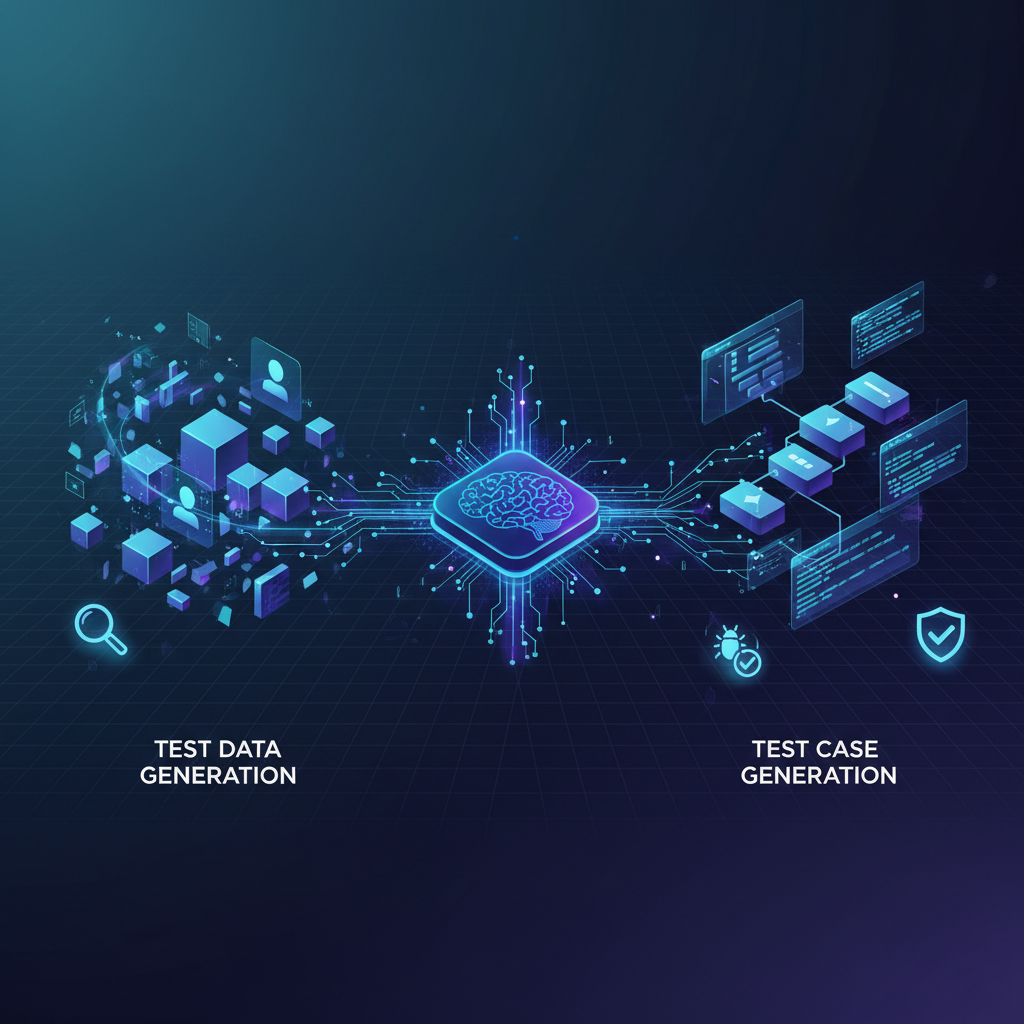
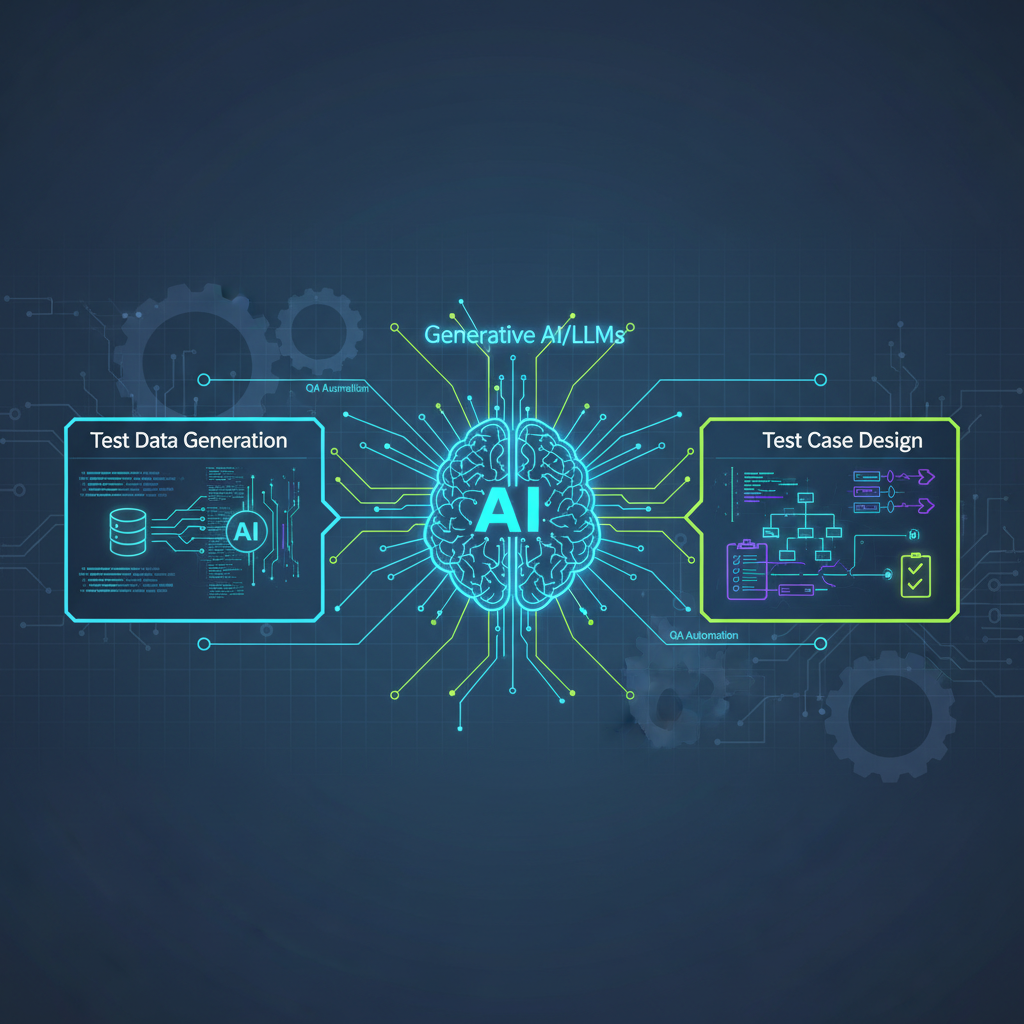
The application of Generative AI in QA primarily bifurcates into two powerful streams: Test Data Synthesis and Test Case Generation.
1. Intelligent Test Data Synthesis
The objective of test data synthesis is to create artificial data that accurately reflects the statistical properties, patterns, and relationships found in real-world data, crucially without exposing any sensitive information. This synthetic data must be diverse enough to cover a wide range of scenarios, including edge cases and boundary conditions, to ensure robust testing.
Key AI Techniques for Data Synthesis:
- Generative Adversarial Networks (GANs): GANs are a pair of neural networks—a generator and a discriminator—locked in a continuous game. The generator creates synthetic data, aiming to fool the discriminator into believing it's real. The discriminator, in turn, learns to distinguish between real and generated data. This adversarial process drives both networks to improve, resulting in highly realistic synthetic outputs. GANs excel at generating complex data types, from realistic images (e.g., synthetic user profile pictures) to tabular data (e.g., customer transaction records) and even text snippets.
- Example: Imagine needing millions of unique customer profiles for load testing an e-commerce platform. A GAN can learn the distribution of names, addresses, purchase histories, and demographic data from a small, anonymized real dataset and then generate an endless stream of statistically similar, yet entirely synthetic, customer records.
- Variational Autoencoders (VAEs): VAEs are a type of generative model that learns a compressed, probabilistic representation (latent space) of the input data. Once trained, new data points can be generated by sampling from this latent space and decoding them back into the original data format. VAEs are particularly effective for structured and semi-structured data, offering good control over the generated data's characteristics.
- Example: For testing a financial application, a VAE could learn the patterns of valid and invalid transaction amounts, dates, and account numbers. It could then generate diverse transaction datasets, including variations that test boundary conditions (e.g., maximum transfer limits, specific date ranges).
- Large Language Models (LLMs): LLMs, such as GPT-4, are powerful tools for generating highly contextual and realistic text-based data. Given a prompt or a few examples, they can produce anything from natural language queries and user reviews to detailed log entries, API request bodies, and even code snippets. Their understanding of language patterns makes them invaluable for text-heavy testing scenarios.
- Example: To test a customer support chatbot, an LLM could generate thousands of unique, nuanced customer queries, including common questions, complaints, feature requests, and even ambiguous or sarcastic inputs, based on a few seed prompts or existing support ticket samples.
- Diffusion Models: Emerging as a powerful class of generative models, diffusion models work by progressively adding noise to data and then learning to reverse this process to generate new data. They have shown remarkable success in generating high-fidelity images, audio, and increasingly, other data types, offering an alternative to GANs with often more stable training.
- Example: For testing an image recognition system that identifies defects in manufacturing, a diffusion model could generate synthetic images of products with various types and severities of defects, augmenting limited real-world defect datasets.
- Rule-Based/Constraint-Based Generation (AI-Enhanced): While not purely generative, these systems can be significantly enhanced by AI. AI can analyze existing data or system specifications to infer complex rules, identify data constraints, and then generate data that strictly adheres to these rules. This is particularly useful when strict data integrity is required.
- Example: For testing a data validation service, AI could infer complex business rules (e.g., "discount codes are only valid for orders over $50 and for new customers") from documentation or existing code, and then generate test data that systematically violates or adheres to these rules.
Practical Applications of Synthetic Test Data:
- Database Mocking: Generate millions of realistic customer records, product catalogs, order histories, and transaction data for performance, load, and stress testing without touching production databases.
- API Testing: Create diverse and complex request payloads (JSON, XML, GraphQL) that adhere to API schemas but intelligently explore edge cases, boundary conditions, and invalid inputs to test API robustness.
- UI/UX Testing: Generate varied user input scenarios for forms, search bars, and interactive elements, including valid, invalid, long, short, and special character inputs.
- AI Model Testing: Create synthetic datasets to test machine learning models, especially for rare events, underrepresented classes, or scenarios where real-world data is scarce or biased. This helps improve model fairness and robustness.
- Security Testing: Generate malicious or malformed inputs, SQL injection attempts, or cross-site scripting payloads to proactively test system vulnerabilities and robustness against attacks.
2. Intelligent Test Case Generation
Beyond just data, Generative AI can automate the creation of entire test cases, including the sequence of actions, input data, and expected outcomes. This moves testing from manual scriptwriting to intelligent, automated scenario design.
Key AI Techniques for Test Case Generation:
- LLMs for Natural Language to Test Case: Given high-level requirements, user stories, functional specifications, or even bug reports in natural language, LLMs can interpret the intent and generate detailed test steps, expected results, and even translate them into structured formats like Gherkin (Given-When-Then) for BDD frameworks.
- Example: A user story "As a customer, I want to be able to reset my password securely" could be fed to an LLM, which then generates test cases covering successful password reset, invalid email, expired token, password strength requirements, and UI navigation steps.
- Reinforcement Learning (RL): An RL agent can interact with an application's UI or API, learning optimal sequences of actions to achieve specific testing goals. The agent receives rewards for covering new code paths, reaching specific application states, or uncovering bugs. This is particularly powerful for exploring complex user journeys and stateful applications.
- Example: An RL agent could explore an e-commerce website, learning to navigate through product categories, add items to a cart, proceed to checkout, and handle various payment scenarios, aiming to maximize code coverage or identify broken flows.
- Evolutionary Algorithms (e.g., Genetic Algorithms): These algorithms mimic natural selection to "evolve" test inputs or sequences. They start with a population of random tests, evaluate their "fitness" (e.g., code coverage, fault detection capability), and then iteratively select, mutate, and combine the fittest tests to generate new, more effective ones.
- Example: For testing a complex mathematical function or a parser, a genetic algorithm could evolve input strings or numerical values that maximize code coverage or trigger specific error conditions.
- Model-Based Testing (AI-Enhanced): AI can learn a model of the system under test (e.g., a state machine, process flow diagram, or behavioral model) from existing code, logs, documentation, or even by observing system behavior. Once a model is learned, AI can then systematically traverse this model to derive comprehensive test paths and generate corresponding test cases.
- Example: AI could analyze application logs and API call sequences to construct a state model of a user's journey through a mobile app. From this model, it could then generate test cases to cover every possible transition and state.
- Program Synthesis (for code-based tests): This technique focuses on generating actual test code snippets (e.g., Python unit tests, Java integration tests) based on function signatures, documentation, existing examples, or even by inferring behavior from the code itself.
- Example: Given a new Python function
calculate_discount(price, quantity, coupon_code), an AI could generate unit tests covering various inputs forprice,quantity, andcoupon_code(valid, invalid, edge cases), along with assertions for expected return values.
- Example: Given a new Python function
Practical Applications of Automated Test Case Generation:
- Unit and Integration Testing: Automatically generate test cases for individual functions, classes, or interactions between services, ensuring comprehensive coverage at lower levels.
- End-to-End Testing: Create complex user journeys and interaction sequences that mimic real-world usage patterns across multiple system components.
- Exploratory Testing Augmentation: AI can analyze system behavior and suggest new test ideas, paths, or scenarios that human testers might overlook, enhancing the effectiveness of exploratory testing.
- Regression Testing: Automatically generate new test cases for changed code sections, identify gaps in existing regression suites, and ensure that new features don't break existing functionality.
Recent Developments and Emerging Trends
The field is rapidly evolving, with several exciting trends shaping its future:
- Prompt Engineering for Test Generation: The art and science of crafting effective prompts for LLMs are becoming crucial. Sophisticated prompting strategies, including few-shot learning, chain-of-thought, and role-playing, are being used to guide LLMs to generate highly relevant, accurate, and structured test data and cases.
- Hybrid Approaches: The most robust solutions often combine the strengths of generative AI with traditional testing techniques. For instance, using LLMs to generate high-level test scenarios, then employing symbolic execution or static analysis to refine inputs and generate precise assertions.
- Feedback Loops and Self-Correction: Integrating AI-generated tests into CI/CD pipelines allows for continuous learning. Test results (pass/fail, coverage metrics, bug reports) can be fed back into the generative models, allowing them to refine their understanding of the system and improve the quality of future test generations. This creates a self-improving testing ecosystem.
- Domain-Specific Model Fine-tuning: Generic generative models are powerful, but fine-tuning them on specific industry data (e.g., healthcare regulations, financial transaction patterns, automotive safety standards) can significantly enhance their accuracy and relevance for specialized testing needs.
- Explainable AI (XAI) for Test Generation: As AI takes on more critical roles, understanding why a particular test case or data point was generated becomes vital. XAI techniques are being developed to provide transparency, allowing testers to trust and debug the AI's outputs more effectively.
- Ethical AI in Synthetic Data: Ensuring that synthetic data doesn't inadvertently perpetuate biases present in the original training data or create new privacy risks is a critical ethical consideration. Research focuses on bias detection, mitigation, and privacy-preserving generative models.
Challenges and Considerations
While the promise is immense, implementing Generative AI in QA comes with its own set of challenges:
- Fidelity vs. Diversity: Striking the right balance between generating synthetic data that is statistically identical to real data (high fidelity) and data that explores diverse, unusual, and edge cases (high diversity) is a continuous challenge. Over-fidelity can lead to missing rare bugs, while over-diversity can generate unrealistic scenarios.
- "Hallucinations" in LLMs: Generative AI, especially LLMs, can occasionally produce plausible but factually incorrect, nonsensical, or irrelevant outputs. Human oversight and validation remain crucial to filter out these "hallucinations" and ensure the generated tests are valid and useful.
- Computational Cost: Training and running complex generative models, particularly GANs and large LLMs, can be resource-intensive, requiring significant computational power and specialized hardware.
- Integration Complexity: Integrating sophisticated AI-driven test generation tools into existing QA workflows, CI/CD pipelines, and legacy systems can be a complex engineering task.
- Data Bias: If the training data used for the generative model contains biases (e.g., underrepresentation of certain user demographics, skewed transaction patterns), the synthetic data and generated test cases will inevitably reflect and potentially amplify these biases.
- Maintaining Relevance: Software systems are not static. As applications evolve, new features are added, and old ones change, the generative models need to be updated, retrained, and re-calibrated to ensure the generated tests and data remain relevant and effective.
Practical Value for AI Practitioners and Enthusiasts
For those passionate about AI, this domain offers a rich tapestry of opportunities:
- Hands-on LLM Application: It provides a tangible, high-impact area to experiment with prompt engineering, fine-tuning LLMs, and integrating them into practical software engineering tools.
- Data Science for QA: This field is ripe for applying advanced statistical modeling, machine learning, and data synthesis techniques to solve real-world problems that directly impact software quality and delivery speed.
- Full-Stack AI Engineering: It encompasses various aspects of AI engineering, from data engineering (for preparing training data) and model development to MLOps (for deploying, monitoring, and maintaining generative models) and software engineering (for integrating AI with testing frameworks and CI/CD).
- Innovation in Software Development: This is a frontier of innovation, offering immense potential for novel research, algorithm development, and the creation of entirely new paradigms for software testing.
- Career Opportunities: The demand for AI engineers, data scientists, and QA professionals with expertise in AI-driven automation is experiencing exponential growth, making this a highly valuable skill set.
Conclusion: A Paradigm Shift in Quality Assurance
Generative AI for Intelligent Test Data Synthesis and Test Case Generation is far more than a theoretical concept; it is rapidly becoming a practical necessity for modern software development. It represents a profound paradigm shift in how we approach quality assurance, moving us beyond reactive bug-finding to a proactive, intelligent, and continuously improving test creation process.
By embracing these AI capabilities, organizations can overcome the traditional bottlenecks of manual testing, enhance test coverage, accelerate release cycles, and ultimately deliver higher-quality software with greater confidence. The future of QA is intelligent, automated, and generative, promising to unlock unprecedented levels of efficiency and reliability in the software we build.