IoT and AI: Navigating the Future of Edge Computing
The Internet of Things (IoT) generates vast amounts of data, creating both opportunities and challenges for Artificial Intelligence. Explore the vision of Edge AI, its potential for automation and efficiency, and the hurdles like privacy and latency that need to be overcome.
The world is awash with data, generated by an ever-expanding universe of connected devices. From the smart thermostat in your home to the industrial sensors monitoring a factory floor, the Internet of Things (IoT) is transforming how we interact with our environment and gather insights. This proliferation of data, however, brings with it a complex interplay of opportunities and challenges, particularly when it comes to harnessing the power of Artificial Intelligence.
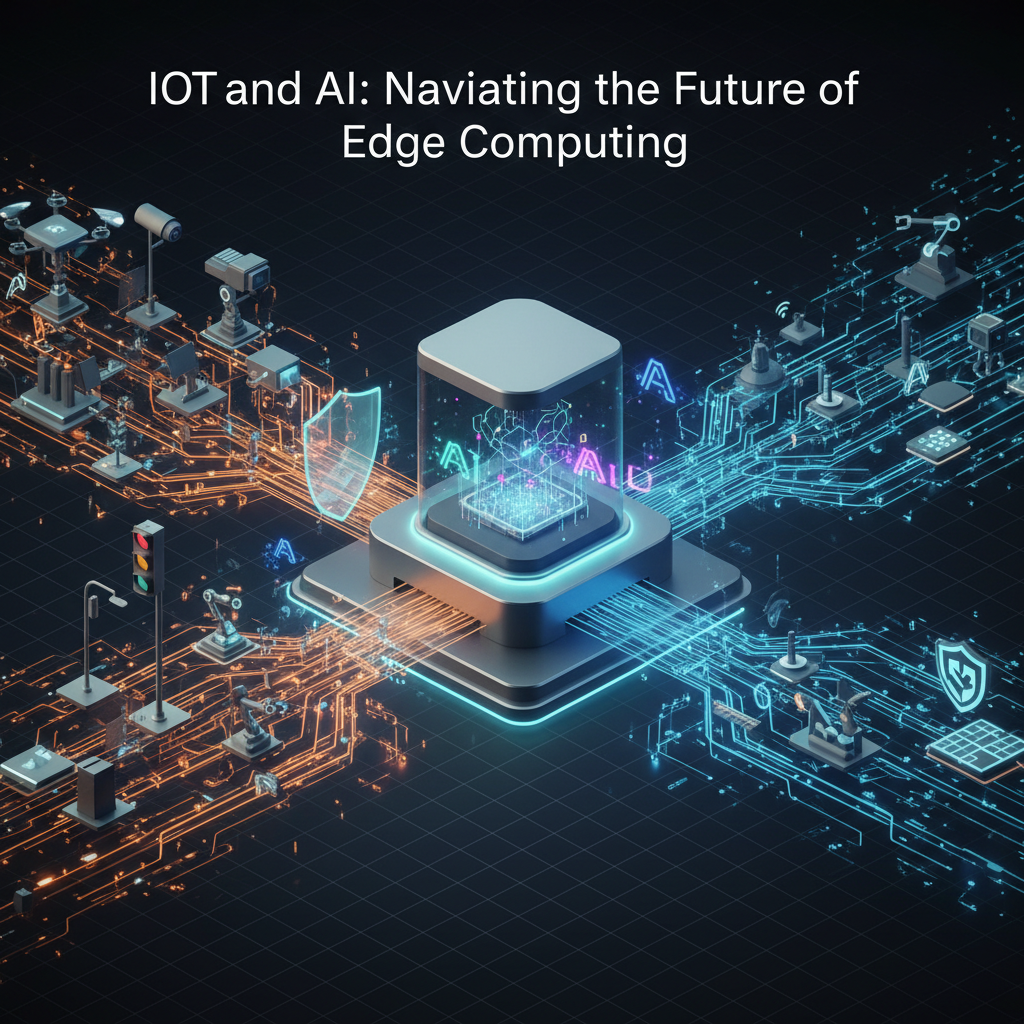
Imagine a future where billions of devices, from tiny wearables to massive autonomous vehicles, are not just collecting data but also intelligently processing it, learning from their surroundings, and making real-time decisions. This vision, often dubbed "Edge AI," promises unprecedented levels of automation, efficiency, and responsiveness. Yet, the path to this future is fraught with hurdles: privacy concerns, bandwidth limitations, latency issues, and the sheer computational demands of modern AI models.
Enter Federated Learning (FL), a revolutionary paradigm that is rapidly emerging as the cornerstone for building privacy-preserving, scalable, and efficient AI systems at the edge. By bringing the AI training process closer to where the data is generated, FL is poised to unlock the full potential of IoT and Edge AI, addressing critical challenges that traditional cloud-centric approaches simply cannot overcome.
The Confluence: IoT, Edge AI, and the Privacy Imperative
To truly appreciate the significance of Federated Learning, we must first understand the landscape it seeks to transform.
IoT & Edge AI: The Distributed Intelligence Frontier
At its core, the Internet of Things (IoT) refers to the vast network of physical objects embedded with sensors, software, and other technologies for the purpose of connecting and exchanging data with other devices and systems over the internet. These devices range from consumer gadgets like smartwatches and security cameras to industrial machinery, agricultural sensors, and medical implants. They generate an unprecedented volume of diverse data – from vital signs and environmental readings to video streams and operational telemetry.
Traditionally, processing this data involved sending it all to a centralized cloud server. However, this approach quickly becomes unsustainable. Consider the implications for:
- Latency-sensitive applications: An autonomous vehicle needs to react in milliseconds, not seconds. Sending raw sensor data to the cloud for processing and then waiting for a decision is simply not feasible.
- Bandwidth constraints: A factory with thousands of sensors generating continuous data streams would quickly overwhelm network infrastructure if all data had to be uploaded.
- Cost: Storing and processing petabytes of raw data in the cloud can be prohibitively expensive.
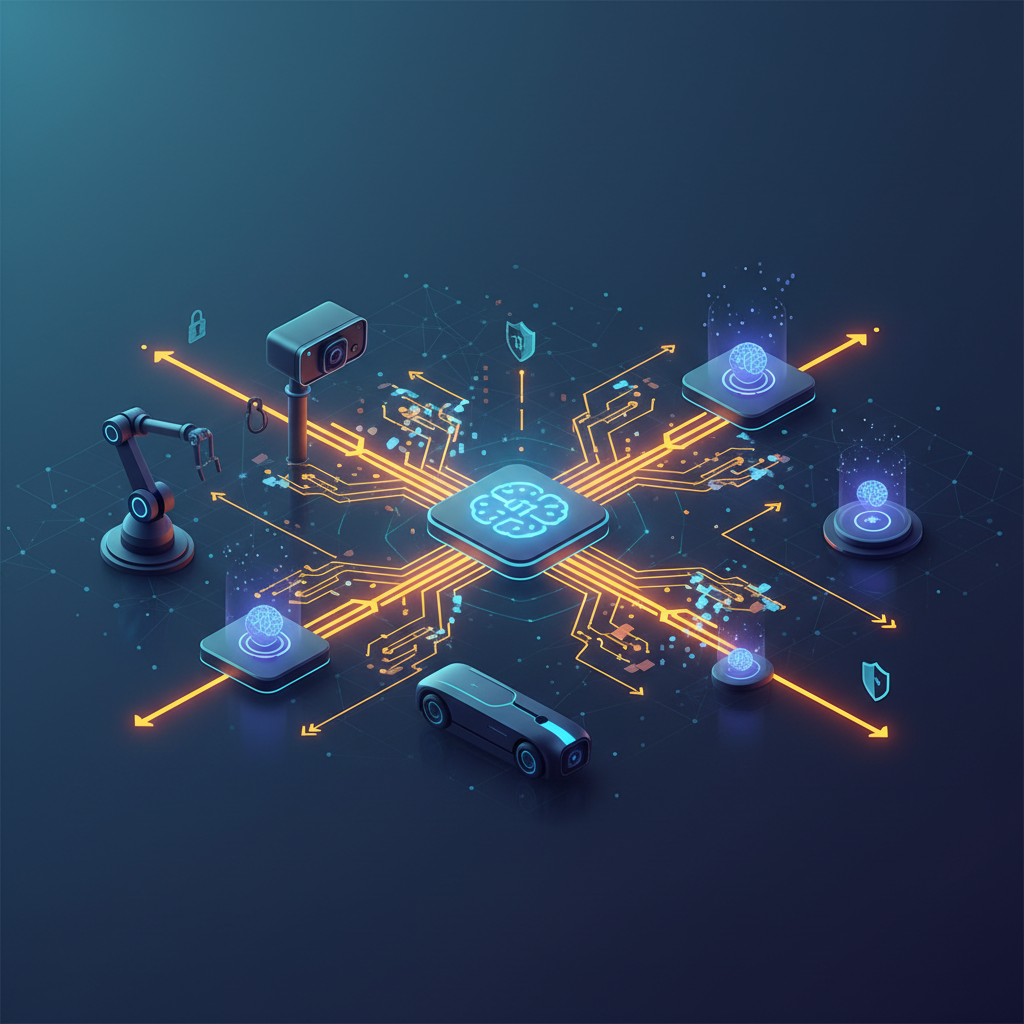
This is where Edge AI steps in. Edge AI involves deploying AI models directly on or very close to the IoT devices themselves. Instead of sending raw data to the cloud, the data is processed locally, and only insights or aggregated results are occasionally transmitted. This dramatically reduces latency, saves bandwidth, and enables real-time decision-making, transforming reactive systems into proactive, intelligent agents. For example, a smart camera with Edge AI can detect an anomaly and alert only when necessary, rather than continuously streaming video to the cloud.
The Central Challenge: Data Privacy and Security
While Edge AI offers immense benefits, it doesn't fully resolve the most pressing issue: data privacy. Many IoT devices collect highly sensitive information. Think about:
- Wearable health monitors: Capturing heart rate, sleep patterns, and activity levels – deeply personal health data.
- Smart home devices: Recording conversations, monitoring movements, and tracking daily routines.
- Industrial sensors: Revealing proprietary manufacturing processes or sensitive operational data.
- Surveillance cameras: Capturing faces and activities in private or public spaces.
Training powerful AI models typically requires centralizing massive datasets to achieve high accuracy. However, centralizing this sensitive IoT data for training raises significant concerns:
- Privacy breaches: A central data repository becomes a single, high-value target for cyberattacks.
- Regulatory compliance: Laws like GDPR (General Data Protection Regulation) and CCPA (California Consumer Privacy Act) impose strict rules on how personal data is collected, processed, and stored, making centralized data aggregation challenging and risky.
- Trust: Users and organizations are increasingly wary of relinquishing control over their data.
The dilemma is clear: we need vast amounts of data to train intelligent AI models, but we cannot, and should not, centralize all sensitive data due to privacy, security, and practical limitations. This is the fundamental problem that Federated Learning was designed to solve.
Federated Learning: Collaborative Intelligence, Distributed Privacy
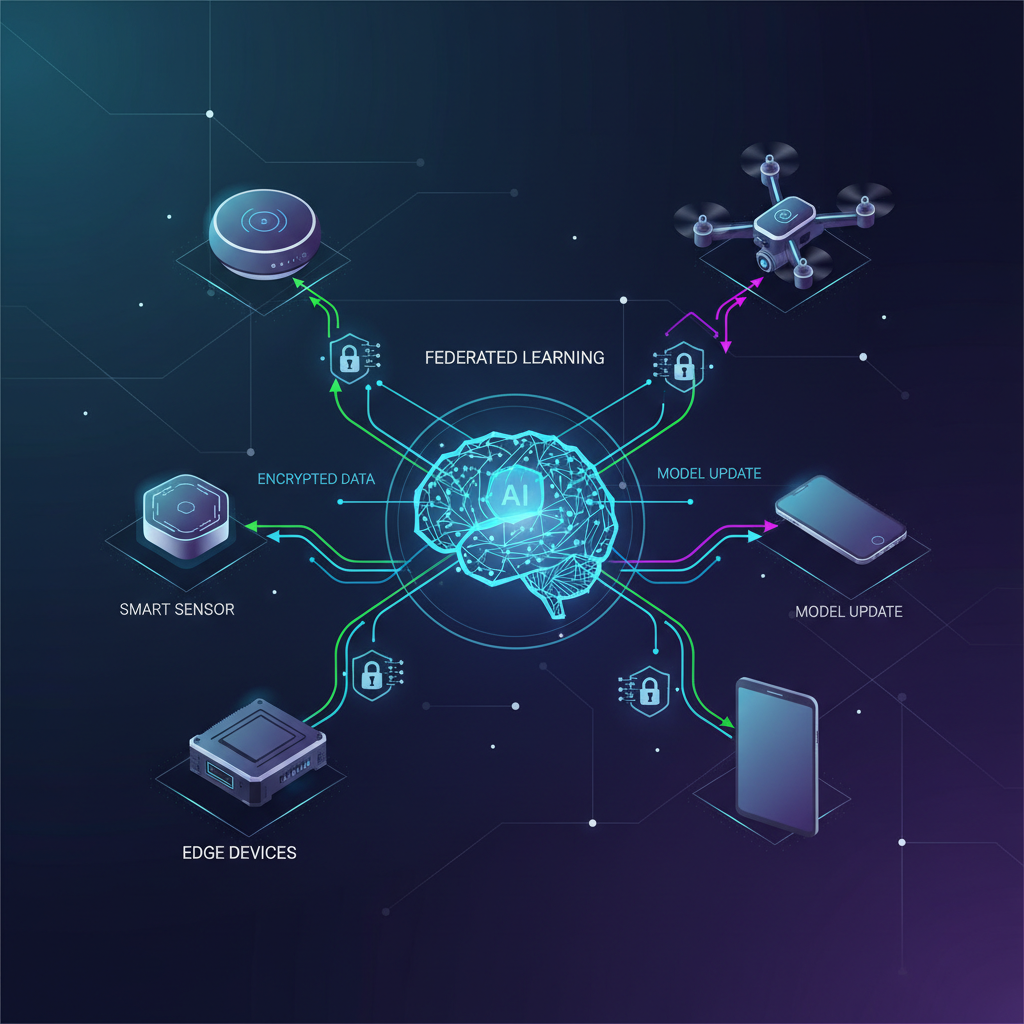
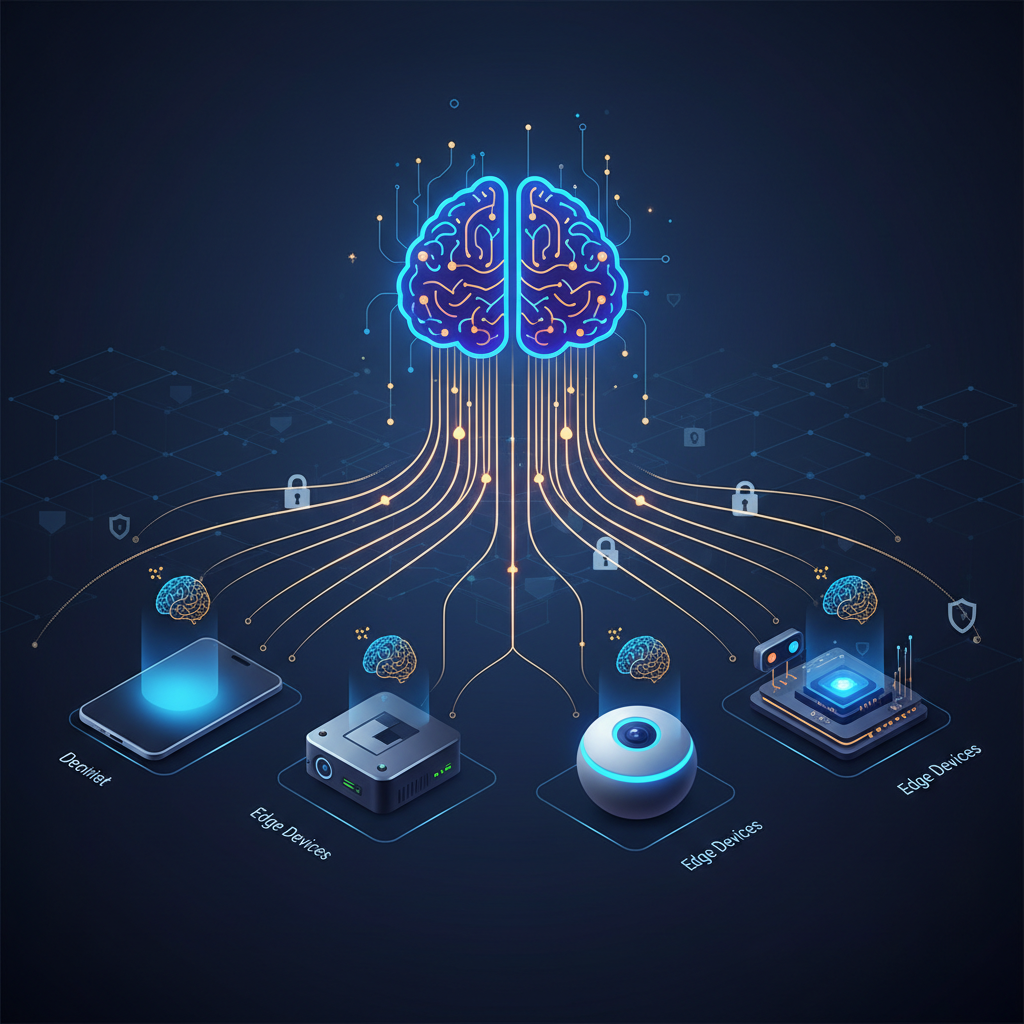
Federated Learning (FL) is a distributed machine learning paradigm that enables multiple clients (e.g., IoT devices, edge gateways, or even organizations) to collaboratively train a shared global model without ever exchanging their raw local data. Instead, the process unfolds as follows:
- Global Model Distribution: A central server (or orchestrator) initializes a global AI model (e.g., a neural network) and distributes it to a selected group of participating clients.
- Local Training: Each client independently trains this global model on its own unique, local dataset. The raw data never leaves the device. This local training updates the model's parameters (e.g., weights and biases).
- Model Update Transmission: Instead of sending their raw data, each client sends only the updates to their local model (ee.g., gradients or updated model weights) back to the central server. These updates are typically much smaller than the raw data itself.
- Secure Aggregation: The central server receives these model updates from multiple clients. It then aggregates them (e.g., by averaging the weights) to create an improved version of the global model. This aggregation process is designed to combine the collective intelligence learned from all participating devices.
- Iteration: The newly aggregated global model is then sent back to the clients, and the process repeats for multiple rounds until the model converges or reaches a desired performance level.
Through this iterative process, the global model learns from the collective experience of all devices without ever seeing any individual device's raw, sensitive data. This fundamentally shifts the privacy paradigm, allowing for powerful AI development while maintaining data locality and enhancing user trust.
Why Federated Learning is Crucial for the IoT Edge
The timing for Federated Learning couldn't be more opportune. Several converging factors underscore its critical importance:
- Escalating Privacy Demands: With data breaches becoming commonplace and privacy regulations tightening globally, FL offers a robust, future-proof solution for developing AI applications responsibly. It allows organizations to comply with regulations while still leveraging data for innovation.
- Explosive Growth of Edge Devices: The sheer volume of IoT devices is overwhelming traditional cloud infrastructure. FL offloads computation to the edge, leveraging the distributed processing power of these devices, making AI scalable for the IoT era.
- Bandwidth and Latency Imperatives: For mission-critical IoT applications like autonomous systems, remote surgery, or industrial control, real-time inference and minimal latency are non-negotiable. FL significantly reduces the need for constant, high-volume data transmission to the cloud, ensuring faster response times.
- Addressing Data Heterogeneity (Non-IID Data): Real-world IoT data is rarely uniformly distributed. Data from one smart camera might differ significantly from another, even in the same city. This "non-IID" (non-independently and identically distributed) nature of data poses a challenge for traditional distributed training. FL research is actively developing techniques to ensure robust global models despite this inherent variability, making it particularly well-suited for diverse IoT environments.
- Energy Efficiency for Constrained Devices: For battery-powered IoT devices, minimizing data transmission is paramount for extending battery life. By processing data locally and only sending small model updates, FL contributes significantly to energy efficiency.
Recent Developments and Emerging Trends: Pushing the Boundaries of FL
The field of Federated Learning is experiencing rapid innovation, moving beyond its initial centralized server-client model to address more complex real-world scenarios and enhance its robustness.
Beyond Centralized FL Architectures
- Hierarchical Federated Learning (HFL): In large-scale IoT deployments, a single central server might still be a bottleneck. HFL introduces intermediate aggregation layers, often at edge gateways. For example, local smart home hubs could aggregate model updates from individual devices (lights, sensors) before sending a consolidated update to a regional server, which then communicates with a cloud-based global aggregator. This multi-tier approach improves scalability, reduces communication load on the central server, and can better handle localized data patterns.
- Decentralized/Peer-to-Peer FL: This takes decentralization a step further by eliminating the central server entirely. Devices directly exchange model updates with their neighbors, often using gossip protocols or blockchain technology for secure, trustless aggregation and incentive mechanisms. This architecture is highly resilient to single points of failure and ideal for highly distributed, dynamic IoT networks without reliable central coordination.
Robustness, Security, and Privacy Enhancements
The promise of privacy in FL needs to be rigorously defended against sophisticated attacks.
- Defense Against Adversarial Attacks: Malicious clients might attempt to "poison" the global model by sending deliberately incorrect or biased updates. Research focuses on robust aggregation algorithms (e.g., Krum, Trimmed Mean) that can detect and mitigate the impact of such outliers. Similarly, inference attacks aim to reconstruct private training data from shared model updates.
- Differential Privacy (DP): This is a gold standard for provable privacy. By adding carefully calibrated noise to the model updates before they are sent to the server, DP guarantees that the presence or absence of any single individual's data in the training set does not significantly alter the outcome of the model. This provides a strong, mathematical privacy guarantee, even against adversaries with significant background knowledge.
- Homomorphic Encryption (HE) / Secure Multi-Party Computation (SMC): These advanced cryptographic techniques allow computations to be performed on encrypted data. In FL, this means clients can encrypt their model updates, send them to the server, and the server can aggregate these encrypted updates without ever decrypting them. Only the final aggregated model is decrypted, ensuring that neither individual client updates nor the aggregated model are revealed to the server, providing an extremely high level of privacy.
Resource Optimization for Constrained Environments
IoT devices often have limited computational power, memory, and battery life.
- Communication Efficiency: The primary bottleneck in FL is often the communication overhead. Techniques like sparsification (sending only the most significant model parameters), quantization (reducing the precision of model parameters), and compression of model updates are crucial to minimize bandwidth usage and accelerate training rounds.
- Client Selection: Not all devices are equally valuable or available for every training round. Intelligent client selection strategies prioritize devices based on data quality, computational resources, battery levels, network connectivity, or even data diversity to optimize training efficiency and model performance.
- Asynchronous FL: In unreliable IoT networks, waiting for all clients to complete a training round (synchronous FL) can lead to significant delays. Asynchronous FL allows clients to send updates at their own pace, and the server aggregates them as they arrive, making the system more robust to device dropouts and varying network conditions.
Personalization and Integration with TinyML
- Personalized Federated Learning: While a global model is beneficial, individual devices often have unique data distributions or user preferences. Personalized FL aims to leverage the global model as a strong foundation, which each device then fine-tunes locally to create a personalized model that performs optimally for its specific context. This offers the best of both worlds: global knowledge and local adaptation.
- Integration with TinyML: TinyML focuses on deploying machine learning models on extremely resource-constrained microcontrollers. Integrating FL principles with TinyML allows for on-device learning even on the smallest IoT nodes, pushing intelligence to the very edge of the network and enabling self-improving, ultra-low-power devices.
Practical Applications: Federated Learning in Action
Federated Learning is not just an academic concept; it's actively being deployed and researched across a myriad of real-world applications, transforming industries and enhancing daily life.
Smart Healthcare: Safeguarding Sensitive Patient Data
- Wearable Health Monitors: Imagine smartwatches and continuous glucose monitors collaboratively training a model to detect early signs of diabetes or cardiovascular issues. FL allows these devices to learn from millions of users' health data without ever sending sensitive patient records to a central cloud, ensuring compliance with HIPAA and similar regulations.
- Medical Imaging Analysis: Hospitals can jointly train AI models for diagnosing diseases from X-rays, MRIs, or CT scans. Each hospital trains on its own patient data, and only model updates are shared, allowing for the creation of more robust diagnostic tools without compromising patient privacy or data sovereignty.
Smart Cities & Transportation: Collaborative Intelligence for Public Good
- Traffic Prediction and Management: Vehicles and roadside sensors can collaboratively train models to predict traffic congestion, optimize traffic light timings, or identify hazardous road conditions. This is done by sharing learned patterns from local traffic flows, rather than revealing individual vehicle routes or speeds, enhancing urban mobility and safety.
- Autonomous Vehicles: FL is critical for accelerating the development of self-driving cars. Vehicles can share learned driving behaviors, environmental perceptions (e.g., object detection models), and anomaly detections (e.g., identifying unusual road debris) without centralizing vast amounts of raw sensor data, which would be bandwidth-prohibitive and privacy-invasive.
Industrial IoT (IIoT) & Manufacturing: Optimizing Operations with Confidentiality
- Predictive Maintenance: Machines in a factory (e.g., CNC machines, robotic arms) can train models on their operational data to predict impending failures. These insights can then be shared across similar machines or even different factories within an enterprise using FL, enabling proactive maintenance without exposing proprietary production details or sensitive operational parameters to a central third party.
- Quality Control: Cameras on assembly lines can collaboratively learn to identify defects in products. By using FL, different production lines or even different manufacturing plants can contribute to a shared defect detection model, improving overall quality without sending potentially sensitive product designs or manufacturing processes to a central server.
Smart Homes & Personal Devices: Personalized Experiences, Private Data
- Personalized Voice Assistants: Devices like smart speakers can improve their speech recognition and natural language understanding models based on individual user interactions and accents. FL allows these devices to learn from user queries without sending private conversations to the cloud, leading to more accurate and personalized experiences while respecting user privacy.
- Smart Camera Security: Home security cameras can train object detection models to identify intruders, package deliveries, or even pets. FL enables these cameras to learn from local feeds, improving their accuracy over time without uploading continuous video streams, which would consume significant bandwidth and raise privacy concerns.
Telecommunications: Enhancing Network Performance
- Network Optimization: Base stations and network devices can collaboratively learn to optimize network performance based on local traffic patterns, user behavior, and interference levels. This allows for dynamic resource allocation and improved service quality without centralizing sensitive network usage data.
Tools and Frameworks for Practitioners
For AI practitioners eager to dive into Federated Learning, several robust open-source frameworks are available:
- TensorFlow Federated (TFF): Developed by Google, TFF is a powerful open-source framework designed for both research and production deployment of federated learning. It provides a high-level API for expressing FL computations and a low-level API for custom FL algorithms.
- PySyft (OpenMined): PySyft is a Python library for secure, privacy-preserving deep learning. It integrates with popular ML frameworks like PyTorch and TensorFlow and includes functionalities for federated learning, differential privacy, and homomorphic encryption, making it ideal for privacy-focused AI development.
- FATE (Federated AI Technology Enabler): Developed by Webank, FATE is an industrial-grade federated learning framework that supports various FL scenarios, including horizontal, vertical, and transfer learning. It offers comprehensive features for data privacy, model training, and deployment.
- Flower: Flower is a flexible and framework-agnostic federated learning framework. It's designed to be easy to use and extend, allowing developers to integrate it with their preferred machine learning frameworks (e.g., PyTorch, TensorFlow, JAX) and customize FL strategies.
These tools empower developers to experiment with FL, build custom solutions, and deploy privacy-preserving AI models at scale.
Conclusion: The Future is Federated and at the Edge
Federated Learning at the IoT Edge is more than just a technological advancement; it represents a fundamental shift in how we conceive, develop, and deploy Artificial Intelligence. It's a paradigm that elegantly reconciles the insatiable data demands of modern AI with the critical imperatives of privacy, security, and efficiency in a hyper-connected world.
For AI practitioners, understanding and mastering FL opens up a vast new landscape of opportunities. It enables the creation of intelligent systems that are not only powerful and accurate but also inherently more ethical, compliant, and sustainable. It's about building trust in AI by design, ensuring that the benefits of advanced analytics can be realized without compromising individual or organizational data sovereignty.
For enthusiasts, FL offers a fascinating intersection of distributed systems, machine learning, cryptography, and real-world impact. It's a field brimming with active research, challenging problems, and the potential to shape the future of smart cities, healthcare, manufacturing, and personal technology.
As billions more devices come online, generating torrents of data at the edge of our networks, Federated Learning will be the key to unlocking their collective intelligence, ushering in an era of truly intelligent, privacy-preserving, and resilient AI. The future of AI is distributed, collaborative, and federated, and it's happening right now, at the edge.